
Table of Contents
Quick Take: Baseline Metrics
- Low-Cost Advantage: Public universities in Germany and France charge as little as €0–€300 annually.
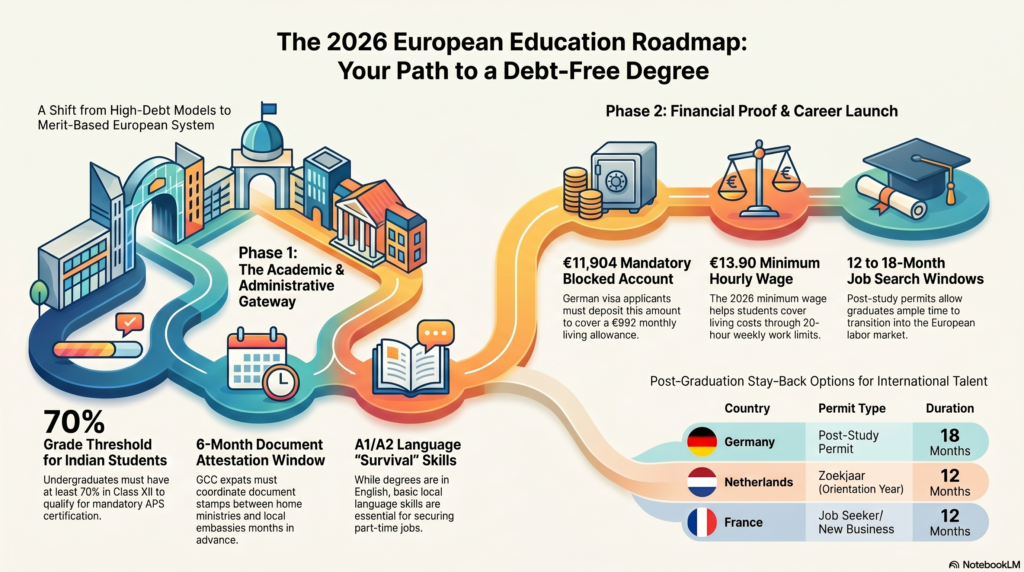
- Visa Funding Requirement: Germany requires €11,904 in a blocked account, with €992 monthly access.
- Career Path Benefit: Germany offers an 18-month post-study permit, while the Netherlands provides a 12-month Zoekjaar.
Content Hook
I recently spoke with a family in Riyadh who were stunned to find that a top-tier degree in Germany or the Netherlands costs a fraction of the price of one in London or New York. For many families across the GCC, Middle Eastern, and South Asian student regions, the dream of international education is often clouded by rising tuition and tightening visa caps in traditional hubs. This guide moves past the marketing noise to provide a clear, expert reality check on why the Europe English-Taught Edge is the most strategic move for your career in 2026. We are looking at a system where academic merit, not just your bank balance, determines your future.
In 2026, Continental Europe represents the Gold Standard for international education by offering a high-caliber return on investment that the UK and US currently struggle to match. For GCC, Middle Eastern, and South Asian students, leveraging this Europe English-Taught Edge opens doors to globally recognized degrees and direct access to the strongest economies in the European Union. Tuition at public institutions often remains below 300 Euro per year, allowing you to allocate your capital toward living expenses and professional networking. This is a pragmatic shift away from lifelong student debt toward a sustainable global career.
| Cost Item | Amount |
| German Public University Tuition | €0–€300/year |
| Uni-assist Application Fee | €75 |
| APS Academic Threshold | 70% (Indian UG applicants) |
TL;DR? Decision Tips
- The Undergraduate 70% Threshold: If you are an Indian student applying for a Bachelor’s degree or Studienkolleg for Winter 2026, your Class XII marks must be at least 70 percent to qualify for an APS certificate.
- The Public Advantage: Public universities offer nearly zero tuition but demand strict academic excellence, while private institutions provide 100 percent English-taught programs with more flexible entry criteria.
- Strategic Language Learning: While your degree is in English, learning basic A1 or A2 German or French is your best tool for securing part-time jobs that pay the 2026 minimum wage of 13.90 Euro per hour.
- Extended Stay Windows: Always target countries with clear post-study paths, such as Germany’s 18-month permit or the 12-month “Zoekjaar” in the Netherlands, to ensure you have time to land a high-value role.
- Attestation Lead Times: If you are an expat in the GCC, you must coordinate document attestations between your home country ministries (like HEC or NADRA) and the local embassies in cities like Dubai or Riyadh at least six months in advance.

Can international students study in Europe for less than €300 per year?
Germany continues to lead the region with its world-famous zero-tuition model at public universities. These institutions prioritize research and technical expertise, but they are not a “backup” option. Admission is highly competitive and requires centralized evaluation through services like uni-assist, which charges 75 Euro for the initial application. You must present a pristine academic record to pass through these state-funded gates.
Reality Check
- What students say: “Public universities are free and easy to get into.”
- What policy shows: APS India 70% threshold and HEC attestation requirements make entry highly competitive for Winter 2026.
- What it means for you: Your 12th-grade marks and document verification through test centers and embassy channels are now your primary gatekeepers.
Beyond the Language Barrier: The Rise of English-Taught Masters
The educational map has expanded significantly, with France and the Netherlands now offering thousands of English-taught programs to attract global talent. This removes the old linguistic barrier for GCC, Middle Eastern and South Asian students who are already proficient in English. While your academic work will be in English, remember that local language skills remain a vital “plus point” for daily survival in local restaurants and cafes. Public Universities support low-cost education for South Asian students. This synergy ensures that high-quality instruction remains accessible to those with the right academic drive.
Post-Graduation Pathways: The Orientation Year Advantage
The transition from student to professional is anchored by generous post-study permits. The French “Job seeker/new business creator” permit gives you 12 months to find a role or launch a startup, while the Dutch “Orientation Year” (Zoekjaar) provides a similar one-year window. In France, to move to a permanent work permit, your salary must typically meet a threshold of 1.5 times the minimum wage. With the 2026 minimum wage sitting at 13.90 Euro per hour, you should aim for a gross monthly salary of approximately 2,281 Euro to secure your long-term status.
Financial Roadmap: Blocked Accounts and Living Costs
Proving your financial stability is a non-negotiable part of the visa process. For Germany in 2026, you must deposit 11,904 Euro into a blocked account, which allows for a monthly withdrawal of 992 Euro to cover living costs. Tuition in other countries varies, though French public universities generally charge around 250 Euro for a Master’s degree. Beyond tuition, you must factor in the Dutch visa fee of 228 Euro, costs for visa medicals, and health insurance premiums that typically range from 120 to 150 Euro per month.
4. What students on Reddit/Quora keep repeating?
- The Housing Crisis: Students frequently claim that finding a room in Berlin or The Hague is harder than the university admission itself. This anxiety is rooted in the very real shortage of student housing in major cities. Alignment: Yes.
- The “English-Only” Job Myth: Some students believe they can land a senior engineering role without any local language skills. The fear of being limited to basic labor is common, and the reality is that professional roles often require at least B1 proficiency. Alignment: No.
- The 70% Rule Shock: Indian applicants often post that their 60 percent score should be enough if they have a great CV. In the 2026 regulatory environment for undergraduate studies, the policy is incredibly strict. Alignment: No.
- Part-time Funding: Many claim that a 20-hour-a-week job covers all their living costs and tuition. While the 13.90 Euro hourly wage helps, relying entirely on this to fund your life is extremely stressful. Alignment: Partly.
- APS Delays: “My APS certificate is taking three months!” is a constant refrain. This reflects the genuine backlog at evaluation centers that can jeopardize intake deadlines. Alignment: Yes.
5. What could go wrong?
- Failing the APS Deadline: Missing the March 15 deadline for Winter 2026 will result in an automatic rejection for undergraduate paths.
- How to reduce this risk: Submit your documents for evaluation at least six months before your intended start date.
- Visa Rejection for Improper Attestation: The embassy will reject files that do not have the required HEC, MOFA, or embassy stamps.
- How to reduce this risk: Ensure all local ministry attestations are completed before you even book your visa interview slot.
- Arriving with Nowhere to Sleep: Arriving in a city like Amsterdam or Munich without a contract can lead to immediate financial and legal trouble.
- How to reduce this risk: Secure housing through university-vetted providers like The Social Hub or Crous residences (France) as soon as you are admitted.
- Underfunding the Blocked Account: Using an unofficial provider or failing to account for transfer fees can lead to a visa denial.
- How to reduce this risk: Only use certified local banks and deposit exactly 11,904 Euro plus the provider’s opening fee.
- Language Isolation: Many students arrive and realize they cannot even read a doctor’s form or a grocery receipt.
- How to reduce this risk: Complete an A1 level language course in your home country during the months before departure.
6. Best-fit profiles
- The STEM Researcher: Students with high marks in Engineering or Biotech looking for low-cost, high-tech labs.
- The Budget-Conscious Career Switcher: Professionals from GCC, Middle Eastern and South Asian students regions who want a Master’s degree without taking out massive loans.
- The Indian UG Achiever: High-school students with 70 percent or higher who want to skip the high costs of US undergraduate degrees.
- The Tech Entrepreneur: Graduates who want to utilize the French “New Business Creator” permit to launch a startup in the EU.
- The Expat Professional: Families living in the GCC who want a safe, international environment for their children to study and work.
7. Misfit profiles
- The Luxury Campus Seeker: Those who expect a gated, resort-style university experience with all-inclusive meal plans.
- The Language-Averse: Students who are fundamentally unwilling to learn any words of German, French, or Dutch.
- The Low-Academic Performer: Indian undergraduate applicants with Class XII scores below 70 percent who are looking for a “shortcut” to Germany.
- The “Instant Wealth” Student: Those who expect a part-time student job to allow them to send thousands of dollars back home every month.
- The Last-Minute Applicant: Anyone who expects to complete the complex attestation and visa process in less than three months.
8. Next Steps
- Coordinate Attestation: Visit HEC, MOFA, or NADRA to verify your degrees and birth certificates. GCC-based expats should check if their local consulate requires home-country legalization first.
- Standardized Testing: Complete your IELTS or TOEFL exams and enroll in a basic European language course.
- Application Submission: Apply through uni-assist or directly to your chosen institutions using Internal Link: Master’s Application Guide.
- Financial Proofing: Open your blocked account and deposit the mandatory 11,904 Euro plus any bank service charges.
- Visa Dossier: Gather your health insurance, proof of address, and attestation documents for your interview using Internal Link: Visa Documentation Checklist.Orientation Year permits assist career transitions for international graduates.
FAQ:
1. What is the APS 70% rule for Indian students?
Starting in early 2026, the Academic Evaluation Centre (APS) India requires undergraduate applicants to have a minimum overall score of 70 percent in their Class XII board exams. This update is a mandatory requirement for both the Studienkolleg and direct Bachelor’s admission pathways. It is essential to note that this rule specifically targets those entering higher education for the first time rather than Master’s applicants.
2. How much does a student visa cost for the Netherlands?
For students targeting the Netherlands in 2026, the visa fee is set at 228 Euro according to current regulations. This fee is paid as part of the application process and is generally non-refundable if your application is not successful. You should also budget for additional costs such as local bank transfer fees and potential document courier charges.
3. Is it possible to work part-time while studying?
Yes, international students are typically permitted to work up to 20 hours per week or 140 full days per year in countries like Germany and France. With the 2026 minimum wage at 13.90 Euro per hour, students can earn roughly 1,112 Euro per month, which covers the government-mandated living expense of 992 Euro. This work authorization is a standard feature of the European student visa, allowing for significant financial independence.
4. How long can I stay in France after I graduate?
The “Job seeker/new business creator” residence permit in France allows graduates to stay for exactly 12 months to find a job or start a company. This permit is non-renewable, so you must secure a qualifying employment contract before the year ends. To transition to a full work permit, your job must usually offer a salary at least 1.5 times the national minimum wage.
5. What is the role of education consultancies in the GCC and South Asia?
Consultancies provide vital support by navigating the specific attestation requirements between local ministries like the HEC and foreign embassies. They help GCC, Middle Eastern and South Asian students avoid common mistakes in document verification and blocked account setup. Many experts also provide interview coaching to help students explain their career goals to visa officers effectively.
6. Do I need to speak German to get a student visa?
If your program is officially taught in English at a private college or certain universities, German proficiency is often not a mandatory visa requirement. However, for public university admissions and your own daily survival, the embassy highly recommends having at least A1 or A2 level skills. Knowing the local language significantly increases your chances of finding a part-time job in the local service sector.
7. What is a blocked account (Sperrkonto)?
A blocked account is a specialized bank account used to prove you have enough money to live in Germany for one year without working. For 2026, the required amount is 11,904 Euro, which is released to you in monthly increments of 992 Euro. This system ensures that all international students have a guaranteed financial safety net during their studies.
8. Are there housing providers specifically for students?
Finding housing is one of the biggest challenges, so students should look for specialized providers like The Social Hub in the Netherlands or Crous residences in France. These organizations offer student-specific contracts that are accepted by embassies as proof of a permanent address. Booking these early is critical as they operate on a first-come, first-served basis and fill up months in advance.
9. Can I travel to other countries while I am a student in Europe?
Your student visa typically grants you access to the entire Schengen area, allowing you to travel freely between member states for short periods. This is a massive benefit for students who want to explore cities like Paris, Amsterdam, and Berlin during their university breaks. Just ensure you always carry your valid passport and residence permit during any cross-border travel.
10. What is the Dutch Zoekjaar permit?
The Zoekjaar, or Orientation Year, is a one-year residence permit that allows graduates of Dutch universities to work for any employer without a separate work permit. It is designed to give you a full 12 months to find a high-level role that matches your degree. This permit is a powerful tool for transitioning from a student visa into the local Dutch labor market.