

Table of Contents
Quick Take: Baseline Metrics
- Ireland Wins on Safety: Ireland outclasses traditional hubs like the UK by ranking in the global Top 5 for safety while offering a neutral, secure, and highly inclusive environment for GCC expats.
- Direct Paths Save Time: Students with British A-Levels or Indian CBSE qualifications can bypass expensive foundation years, matching entry requirements directly into major Irish universities.
- Clear Route to Permanent Status: A Level 9 degree unlocks an automatic 24-month stay-back visa, bridging directly to a Critical Skills Permit (minimum €40,904 salary) and permanent residency.
Content Hook:
The geopolitical shifts of 2026 have fundamentally reordered the priorities of Gulf Cooperation Council (GCC) expat families evaluating international higher education. Traditional Western hubs like the United Kingdom and France face intensifying structural challenges, characterized by stringent international student immigration caps, macroeconomic instability, and shifting social dynamics that compromise student security. For non-EU passport holders specifically Middle Eastern and South Asian expats residing in Riyadh, Dubai, Doha, and Muscat the choice of an academic destination is no longer just about institutional rankings. It is an intricate optimization problem balancing personal safety, cultural inclusivity, straightforward academic progression, and a reliable Return on Investment (ROI) via a direct pathway to permanent residency.
Ireland is the safest European country for GCC expat students seeking permanent residency, combining top-tier Global Peace Index marks with direct, non-foundation pathways and streamlined, post-study work visas.
TL;DR Highlights: safest European country
- The “Basic Salary” Rule Enforcement: To secure a 10-year residency via the UAE Golden Visa, skilled professionals must hit the AED 30,000 monthly threshold exclusively through their basic salary, as regional immigration authorities no longer factor in total compensation or allowances.
- Oman’s Historic Fiscal Shift: Oman breaks historic GCC ground by introducing a 5% personal income tax via Royal Decree No. 56/2025; effective January 1, 2028, it impacts high-earning individuals making over OMR 42,000 (~USD 109,000) per annum.
- Western Compliance Premium: Multinational corporations in the DIFC and QFC aggressively target European alumni because their academic training naturally aligns with complex cross-border compliance, ESG metrics, and international common-law frameworks.
- Bypassing the Foundation Year Friction: GCC expatriate families can entirely eliminate the unnecessary financial burden of international foundation programs by selecting European universities that accept direct qualification mappings for British A-Levels and Indian CBSE frameworks.
- Strategic Academic Arbitrage: For South Asian and Middle Eastern students, a top-tier European degree serves as a high-leverage structural bridge to bypass entry-level regional bottlenecks, moving directly into premium executive roles in Dubai and Doha.
Who Is This Guide For?
This guide is designed for:
- GCC-based expatriate families living in Dubai, Abu Dhabi, Sharjah, Doha, Riyadh, Jeddah, Muscat, Kuwait City, and Manama.
- Indian, Bangladeshi, Nepalese, and Sri Lankan students studying in CBSE, ISC, IB, British Curriculum, or American Curriculum schools across the GCC.
- Parents seeking a safe European destination that offers long-term career opportunities and a clear pathway to residency.
- Working professionals in the GCC considering a master’s degree that supports future immigration and career growth.
What Is the Safest European Country for GCC Expat Students in 2026?
For GCC-based international students seeking a combination of safety, post-study work opportunities, and long-term residency prospects, Ireland remains one of the strongest options in Europe in 2026. The country consistently ranks among the world’s safest nations, offers English-taught programs, provides a two-year post-study work pathway for master’s graduates, and maintains a relatively transparent route toward long-term residence compared to many competing destinations.
Safest European Study Destinations for GCC Expats: The Landscape
The Safety Imperative: Evaluating Geopolitical and Municipal Risks for Non-EU Students
Evaluating sovereign stability, international neutrality records, and local urban safety metrics is critical for protecting vulnerable third-country national students migrating from the GCC.
When assessing long-term student relocation, risk analysts divide safety into macro-level geopolitical stability and micro-level municipal security. For expatriate families in the Gulf, whose home-country passports often carry strict visa limitations within the Schengen zone, localized civil unrest or macro-level alignment with volatile military coalitions poses an existential threat to post-graduation survival. A nation’s structural vulnerability to international conflict directly shapes its domestic immigration climate, influencing how minority student groups are integrated into local communities.
Why Safety Matters for GCC Families
Safety is often one of the most important factors influencing study abroad decisions for GCC-based families.
Beyond personal security, parents frequently evaluate:
- Political stability.
- Quality of healthcare.
- Public transportation safety.
- Student support services.
- Social inclusion for international students.
- Long-term career and residency prospects.
Countries that combine strong safety rankings with stable immigration pathways tend to provide better outcomes for international students over the long term.
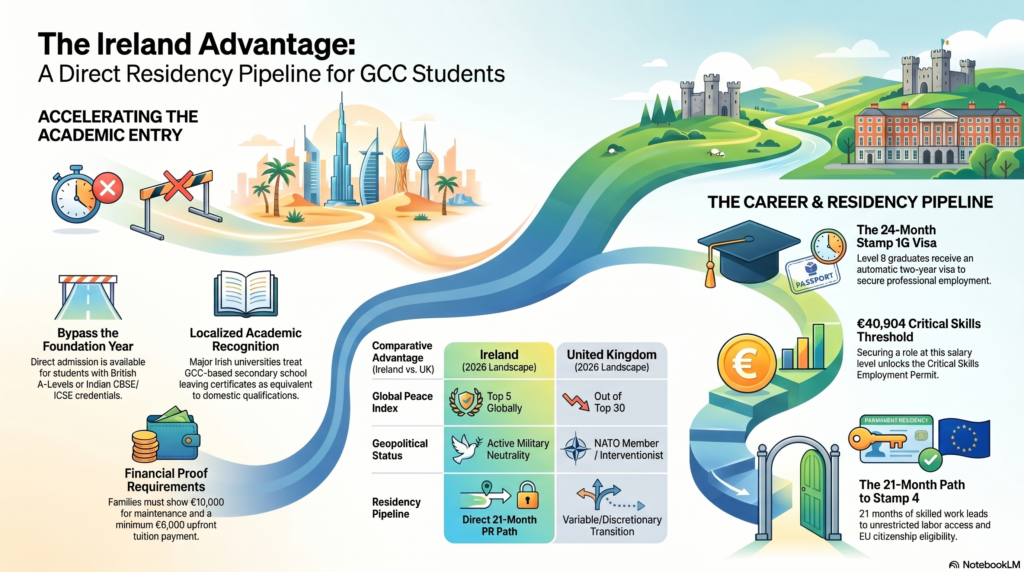
Ireland vs. UK: Comparing Global Peace Index (GPI) and Neutrality Status
Ireland consistently outranks the United Kingdom across all major safety indexes due to its constitutional military neutrality and low violent crime rates.
| Country | 2026 GPI Rank | Geopolitical Status | Municipal Crime Risk | Hate Crime Protections |
| Ireland | Top 5 Globally | Active Military Neutrality | Low/Negligible | Comprehensive National Strategy |
| United Kingdom | Out of Top 30 | NATO Member / Interventionist | Moderate (City-dependent) | Varied Regional Frameworks |
Ireland vs United Kingdom for GCC Expat Students
| Factor | Ireland | United Kingdom |
|---|---|---|
| Primary Language | English | English |
| Global Safety Reputation | Consistently among the world’s safest countries | Generally safe but lower safety rankings than Ireland |
| Post-Study Work Period | Up to 2 years for eligible graduates | Up to 2 years for eligible graduates |
| Long-Term Residency Pathway | Clear employment-based routes available | More complex immigration pathways |
| Direct Entry for CBSE/A-Level Students | Widely available | Widely available |
| Popular Sectors | Technology, Pharmaceuticals, Finance | Finance, Technology, Healthcare |
Direct Educational Transition Strategies for GCC & South Asian Expats
Eliminating the Foundation Year: From UAE/Qatar Curriculums to Europe
GCC expat students can systematically bypass costly, time-consuming international foundation years by strategically mapping secondary school leaving credentials directly to European frameworks.
The traditional international foundation year is frequently an unnecessary financial friction point imposed by universities on non-EU applicants. For expatriate families in the Gulf navigating high local living costs, eliminating this intermediary step saves an entire year of tuition and accommodation fees. By selecting a European destination that evaluates foreign secondary school curricula symmetrically against domestic leaving certificates, students can accelerate their entry into high-value degree programs.

Aligning British A-Levels and CBSE with Irish University Entry Requirements
Major Irish universities recognize British GCE A-Levels and Indian CBSE board exams for direct undergraduate admission without mandatory foundation programs.
- Direct A-Level Equivalency: Major Irish institutions directly evaluate British GCE A-Levels on a specific tariff point system, treating them equivalently to the Irish Leaving Certificate.
- CBSE/ICSE Direct Entry: Top-tier Indian central boards taught across the GCC are recognized for straight undergraduate entry, provided specific grade thresholds (e.g., overall 85–90%) are met.
- Centralised Application Options: Highlighting the streamlined application pathways via university portals or specific educational consultants that bypass complex regional processing.
GCC Student Choosing Ireland
A CBSE student studying in Dubai who graduates with 85–90% in Grade 12 and an IELTS score of 6.5 may be eligible for direct entry into many Irish undergraduate programs without completing an additional foundation year.
After graduation, the student can benefit from Ireland’s post-study work permissions, gain professional experience, and potentially transition toward long-term residency pathways through eligible employment sectors.
What Has Changed for Students in 2026?
Several factors continue to influence international student decision-making in 2026:
- Increased competition for study visas across major destinations.
- Growing demand for countries with clear post-study work opportunities.
- Greater emphasis on employability and graduate outcomes.
- Rising interest in residency-focused study destinations.
- Continued demand from GCC expatriate families seeking long-term stability through international education.
Students should always verify the latest visa, residency, and university requirements through official government and institutional sources before applying.
The Safe-Haven Visa & Permanent Residency (PR) ROI
The 24-Month Post-Study Work Visa Advantage in Ireland
Ireland’s Level 9 post-graduate framework grants an automatic 24-month post-study work visa, offering an unbending domestic bridge to multinational corporate recruitment.
The financial rationale for international education depends heavily on the duration and legal accessibility of the post-study work visa framework. While other European nations have scaled back stay-back privileges or introduced arbitrary salary minimums that clear out entry-level non-EU graduates, Ireland preserves a predictable regulatory runway. This allows non-EU expatriates to secure employment within the continent’s most densely concentrated technology and financial services hubs without immediate corporate visa sponsorship.
Transitioning from Stamp 1G to the 2026 Critical Skills Employment Permit (CSEP)
The explicit migration pipeline in Ireland allows non-EU graduates to move swiftly from temporary stay-back status to permanent domestic labor market access.
- Graduation & Stamp 1G: Secure a 24-month automatic stay-back visa (Level 9 degree) to seek graduate-level employment.
- CSEP Job Offer: Secure a role on the Critical Skills Occupations List meeting the updated minimum €40,904 salary threshold.
- The Stamp 4 Transition: Work for 21 months under the CSEP to receive a Stamp 4, granting unrestricted domestic labor market access and establishing the foundation for naturalized EU citizenship.
THE LOCALIZATION & TRUST HOOKS
Navigating cross-border financial compliance requires meticulous synchronization between GCC corporate banking networks and European immigration proof-of-funds policies.
For an expatriate family processing high-value cross-border transactions from the Gulf, financial proofing is an exacting regulatory hurdle. The Irish Naturalisation and Immigration Service (INIS) enforces stringent guidelines designed to verify the liquid provenance of funds before an entry clearance visa is issued. When initiating transfers via commercial institutions like Emirates NBD, Qatar National Bank (QNB), or Al Rajhi Bank, sponsors must maintain an unencumbered balance of at least €10,000 for student maintenance, alongside verified receipts of an upfront tuition installment of at least €6,000.
Furthermore, the municipal environment of secondary hubs like Cork, Galway, and Limerick offers a welcome relief from the distinct social anxieties faced by minority students in sprawling, fragmented metropolises. These mid-sized university cities are highly compact and intensely walkable, featuring robust, established multicultural networks and halal dining options that integrate seamlessly with on-campus student welfare frameworks.
Crucially, this specialized transition structure honors local secondary academic benchmarks. Whether a student is presenting the UAE Ministry of Education (MoE) curriculum, the Qatar Senior School Certificate, or credentials from premium British and Indian international school networks across Riyadh and Muscat, applications are assessed within a clear, standardized matrix. This localized transparency ensures families can accurately project admission outcomes without facing unexpected regional academic detours.
Key Takeaways:
- Ireland remains one of the safest European countries for GCC-based students in 2026.
- English-taught education makes the transition easier for CBSE, British Curriculum, and IB students.
- Eligible graduates can access post-study work opportunities that support long-term career growth.
- Many GCC students can gain direct university admission without a foundation year.
- Early planning improves visa, funding, and residency outcomes.
#FAQ:
1. Which European country is safest for GCC expat students looking for permanent residency?
Ireland is widely considered the safest European country for GCC expat students looking for permanent residency, offering top-five global safety rankings and an expedited 21-month pathway to permanent status via skilled employment.
2. What is the minimum salary required for a Critical Skills Employment Permit in Ireland for 2026?
Effective March 1, 2026, the minimum annual salary threshold required to qualify for a standard Critical Skills Employment Permit in Ireland is €40,904.
3. How much money do GCC expat students need to prove for Irish student visa living costs?
International students applying for an Irish study visa must demonstrate immediate, unencumbered access to at least €10,000 per year for living expenses, exclusive of tuition fees.
4. Can UAE and Qatar British-curriculum students apply directly to Irish universities?
Yes, students graduating from UAE and Qatar international schools with recognized British A-Levels can apply for direct undergraduate admission to Irish universities without completing an extra international foundation year.
5. How do post-study work visa timelines in Ireland compare to the UK Graduate Route?
While the UK Graduate Route grants a two-year unsponsored stay-back visa, Ireland’s equivalent 24-month Stamp 1G visa provides a far more secure, direct transition into a non-discretionary permanent residency pipeline through its Critical Skills framework.
6. Are South Asian expat students from the GCC subject to additional language testing for Irish visas?
GCC expat students who have completed their full secondary education at an English-medium international school using a British curriculum can frequently secure university English waivers, though the Irish immigration system may still require an official IELTS or Duolingo English Test score for final visa clearance.