


Table of Contents
Quick take: June 2026
- German Escrow Targets: Statutory balances mandate a €11,904 baseline minimum deposit for all incoming international student visas.
- French Monthly Limits: Consular frameworks demand verified access to at least €615 monthly via flexible liquid capital assets.
- Erasmus Living Stipends: Approved scholars receive an un-capped monthly living allowance of €1,400 throughout the academic cycle.
- Part-Time Work Caps: Germany restricts student labor allocations to 140 full days or 280 half days annually.
Content Hook:
Navigating the volatile financial landscape of South Asia has made the dream of international education increasingly complex for ambitious students. South Asian currency controls, tightening domestic capital regulations, fluctuating parallel market rates, and sudden central bank restrictions frequently trap middle-class families in Bangladesh and Nepal, as well as corporate expats looking to fund their children’s education from the GCC. For these students, elite continental European universities offer a powerful alternative: world-class education paired with little to no tuition fees, effectively reducing dependence on restrictive domestic banking channels and providing a practical pathway around the challenges created by South Asian currency controls.
You can fund a European student visa under strict currency limits by securing fully funded Erasmus+ stipends, utilizing international third-party financial sponsors, or leveraging offshore GCC bank accounts.
TL;DR Highlights:
- European scholarships help students bypass South Asian currency restrictions: Fully funded programs like Erasmus Mundus eliminate dependence on restrictive banking systems in countries like Bangladesh and Nepal.
- Germany and France offer low-cost study pathways: Germany’s public universities charge little to no tuition, while France provides heavily subsidized education and student housing support.
- GCC-based sponsors can legally support Schengen student visas: Relatives in the UAE, Qatar, or Saudi Arabia can provide financial guarantees and blocked account funding for European visa applications.
- Digital blocked account providers simplify German visa compliance: Platforms like Expatrio and Fintiba help students meet Germany’s €11,904 financial requirement without relying entirely on local banks.
- Strategic financial planning protects families from remittance delays and currency volatility, creating a safer long-term pathway toward European education, residency, and global career mobility.
What Are Currency Controls?
Currency controls are government regulations that manage how money enters or leaves a country. These controls can affect international students by influencing tuition payments, living expense transfers, foreign exchange availability, and education-related remittances.
For students planning to study abroad, understanding these regulations is critical to avoiding delays in university fee payments and visa documentation.
Can South Asian Students Still Pay Tuition Fees Abroad?
Yes. Most South Asian countries provide legal channels for education-related remittances, even during periods of foreign exchange restrictions. However, students may need additional documentation such as university admission letters, fee invoices, proof of enrollment, and banking approvals before funds can be transferred.
The South Asian Capital Crisis: Remittance Caps vs. Study Abroad Ambitions
Navigating Bangladesh Bank Outward Remittance Restrictions
Bangladesh Bank enforces strict regulations on outward student remittances, requiring formal registration of student files through authorized dealer commercial banks.
When navigating the fund European student visa currency limits Bangladesh parameters, students face tight scrutiny under the Guidelines for Foreign Exchange Transactions. Local commercial banks require meticulous documentation to release foreign currency and prevent illicit capital flight. To avoid processing delays that risk university seat deposits, applicants must compile a legally bulletproof financial file.
- Passport Verification Details: Must show a valid passport with at least six months of validity beyond the intended course start date.
- Official Offer Letter: An unconditional acceptance letter from an accredited European institution detailing exact tuition and institutional fees.
- Educational Academic Credentials: Attested copies of the Higher Secondary Certificate (HSC), A-Levels, or equivalent transcripts and certificates.
- University Routing Numbers: Explicit international banking details, including SWIFT/BIC codes and IBAN configurations, for direct institutional transfers.

Nepal’s No-Objection Certificate (NOC) and Capital Outflow Rules
Nepal Rastra Bank mandates a Ministry of Education issued No-Objection Certificate before any commercial bank can legally execute outward Euro currency remittances.
The regulatory framework enforced by Nepal Rastra Bank creates operational friction for students heading to the Schengen zone. Without a validated No-Objection Certificate (NOC) issued by the Ministry of Education, Science, and Technology in Kathmandu, local banks cannot sell foreign exchange. This multi-layered bureaucratic compliance process requires an exact operational sequence to ensure timely capital deployment.
[University Unconditional Offer] ➔ [Apply for Ministry of Education NOC] ➔ [NRB Authorized Bank Verification] ➔ [Foreign Exchange Allocation & Swift Transfer]
How to Legally Transfer Money Abroad for Education
Step 1: Obtain University Admission
Secure an official offer letter or confirmation of enrollment.
Step 2: Collect Required Financial Documents
Prepare tuition invoices, passport copies, visa documents, and proof of admission.
Step 3: Contact an Authorized Bank
Use only approved banking channels for international education payments.
Step 4: Complete Compliance Requirements
Submit any country-specific foreign exchange documentation requested by the bank.
Step 5: Track Exchange Rates
Monitor currency fluctuations to reduce unexpected increases in education costs.
How Currency Controls Affect Students Across South Asia
India: Liberalised Remittance Scheme (LRS) and Overseas Education
India offers one of the most structured frameworks for funding overseas education through the Reserve Bank of India’s Liberalised Remittance Scheme (LRS). Under this scheme, resident individuals can legally remit foreign currency for approved purposes, including university tuition fees, living expenses, accommodation, and other education-related costs abroad.
RBI LRS Limits
The Liberalised Remittance Scheme allows eligible Indian residents to transfer funds overseas within the limits prescribed by the Reserve Bank of India. These remittances can be used for tuition fees, hostel charges, living expenses, examination fees, and other approved educational expenditures. Students and families should verify the latest RBI guidelines before initiating transfers, as regulations may change periodically.
Education Loan Exemptions
Students financing their studies through approved education loans may benefit from specific regulatory provisions that differ from self-funded remittances. Education loans from recognized financial institutions often provide greater flexibility for overseas study expenses while helping families manage large tuition payments over time.
Tuition Remittances
Most universities require tuition deposits before issuing final enrollment confirmations. Indian students typically transfer these funds through authorized banks or approved foreign exchange providers after submitting admission letters, fee invoices, passport copies, and other supporting documents. Planning remittances well in advance helps avoid delays during peak admission seasons.
TCS Implications
Tax Collected at Source (TCS) may apply to certain overseas remittances under prevailing Indian tax regulations. Students and parents should understand applicable thresholds, exemptions, and refund procedures while planning their study abroad budgets. Consulting a qualified tax advisor can help families accurately estimate total education costs and maintain compliance.
Bangladesh: Managing Overseas Education Payments During FX Restrictions
Students from Bangladesh often need to navigate foreign exchange regulations while arranging overseas education funding. During periods of foreign currency pressure, banks may require additional documentation before approving education-related remittances.
Bank Approval Requirements
Authorized banks generally require verification of educational purposes before processing international transfers. Students may need to provide official university admission letters, tuition invoices, passport details, and visa documentation before approval is granted.
Tuition Payment Documentation
Accurate documentation is critical for timely processing. Universities frequently issue official fee statements that banks use to validate payment requests. Missing or incomplete documentation can delay tuition transfers and impact admission timelines.
Scholarship Fund Transfers
Students receiving scholarships, grants, or sponsorship support should maintain records of award letters and funding confirmations. These documents help demonstrate legitimate educational purposes and may simplify banking procedures related to overseas fund transfers.
Nepal: Foreign Currency Allocation for Study Abroad
For many Nepalese students, studying abroad requires approval for foreign currency allocation through authorized banking channels. Proper documentation and advance planning are essential to ensure tuition payments are processed smoothly.
Bank-Issued Foreign Exchange Permissions
Banks may require approval and verification before releasing foreign currency for educational purposes. Students should begin the process early to account for administrative timelines and regulatory requirements.
University Fee Documentation
Official tuition invoices, enrollment confirmations, and university-issued payment instructions are often required when requesting foreign currency for overseas studies. Keeping documentation organized can significantly reduce processing delays.
Proof-of-Admission Requirements
Admission letters serve as one of the most important supporting documents during the remittance process. Banks and regulatory authorities may use these documents to verify the legitimacy of the educational transfer request and determine eligibility for foreign currency allocation.
Sri Lanka: Overseas Education Funding During Currency Volatility
Exchange-rate fluctuations can significantly influence the overall cost of studying abroad for Sri Lankan students. Even small currency movements can affect tuition fees, accommodation expenses, and living costs over the duration of a degree program.
Exchange-Rate Fluctuations
When local currency values change rapidly, the actual cost of overseas education can increase unexpectedly. Students should monitor currency trends regularly and factor potential exchange-rate movements into their financial planning.
Tuition Planning
Families can reduce financial uncertainty by budgeting for future tuition installments, maintaining contingency funds, and exploring scholarship opportunities. Early financial preparation can help minimize the impact of unfavorable currency movements.
Documentation Requirements
Banks typically require supporting documentation such as university admission letters, tuition invoices, passport copies, visa documents, and proof of enrollment before processing overseas education payments. Maintaining complete records helps ensure smoother fund transfers and fewer administrative delays.
| Country | Primary Regulator | Common Student Requirement | Typical Challenge |
|---|---|---|---|
| India | RBI | LRS documentation | Managing tuition and living expenses under annual limits |
| Bangladesh | Bangladesh Bank | Proof of admission and fee invoices | Access to foreign currency |
| Nepal | Nepal Rastra Bank | University acceptance documents | Foreign currency allocation approvals |
| Sri Lanka | Central Bank of Sri Lanka | Bank compliance documentation | Exchange-rate volatility |
The Euro Scholarship Escape Hatch: Erasmus+ and Zero-Tuition Pathways
Erasmus Mundus Joint Masters: Total Financial Independence
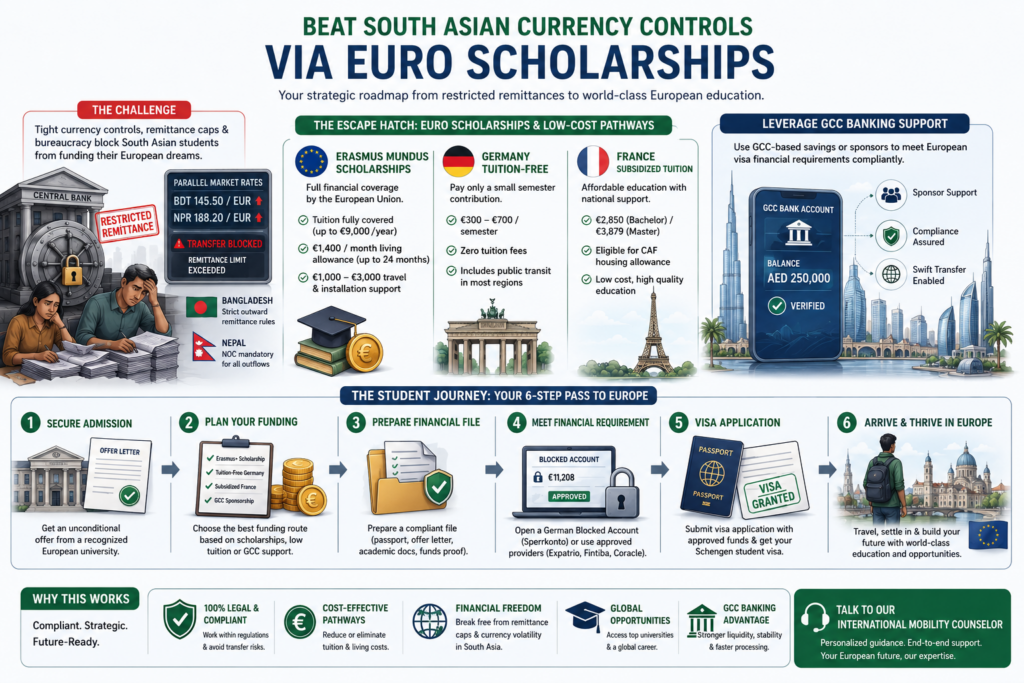
The Erasmus Mundus scholarship provides South Asian students up to twenty-four months of full financial coverage, entirely bypassing domestic central bank capital restrictions.
The Erasmus Mundus scholarship South Asian students pathway represents the ultimate mechanism for total financial autonomy. Because the European Union funds the entire academic lifecycle directly, scholars do not need to open local student bank files or seek outbound remittance approvals from their home central banks. This eliminates the risk of parallel market exchange rate losses.
| Component | Amount and Coverage Scope |
| Tuition and Institutional Fees | Fully covered up to €9,000 per academic year paid directly to the consortium. |
| Monthly Living Allowance | €1,400 per month for up to 24 months to cover all European maintenance costs. |
| Travel and Installation Costs | €1,000 to €3,000 per year based on distance, plus a €1,000 one-time setup stipend. |
Tuition-Free Degrees in Germany and France for Non-EU Nationals
Germany and France offer low-barrier financial pathways by providing tuition-free or highly subsidized university programs that reduce upfront international capital requirements.
By targeting countries with low or non-existent tuition structures, South Asian applicants dramatically reduce the volume of foreign currency they must legally export. German public universities charge no tuition to international students, demanding only nominal administrative fees. Meanwhile, French public institutions offer highly competitive rates under national subsidy frameworks, minimizing capital flight worries.
| Country | University System Type | Cost Structure (Per Academic Year) | Primary Capital Advantage |
| Germany | Public Universities | €300 – €700 (Semester Contribution) | Zero tuition fees; includes regional public transit ticket. |
| France | Public (Bienvenue en France) | €2,850 (Bachelor) / €3,879 (Master) | Subsidized tuition; qualifies for CAF national housing allowance. |
Bypassing Domestic Banks: Compliant Blocked Account Navigation
Demystifying the German Blocked Account Requirement (Sperrkonto)
The Germany blocked account requirements demand international students deposit a legally mandated minimum sum into an escrow account to verify sufficient subsistence funds.
For students navigating the fund European student visa currency limits Bangladesh landscape, satisfying the German Federal Foreign Office requirement can be challenging due to local outbound bank delays. Utilizing digital providers approved by the German government, such as Expatrio, Fintiba, or Coracle, allows families to secure their visas smoothly. Many families rely on third-party sponsors in the GCC or existing offshore funds to bypass domestic banking bottlenecks entirely.
Expatrio Regulatory Framework
- Total Required Capital: €11,904 per calendar year held in escrow.
- Monthly Capped Payout: €992 per month disbursed to the student’s local European bank account.
France Student Visa Financial Proof: Low-Threshold Safe-Havens
The France student visa financial proof framework requires applicants to demonstrate reliable monthly resources without demanding large upfront escrow account deposits.
Compared to Germany’s strict upfront escrow mandates, the French consular framework via Campus France and VFS Global offers greater flexibility under capital controls. Students must demonstrate they have access to a specific monthly subsistence amount, which can be verified using a variety of flexible funding methods rather than a single lump-sum transfer.
- Monthly Maintenance Threshold: Must demonstrate a minimum of €615 per month for the duration of the academic year.
- Certified Bank Statements: Three months of consecutive local or international bank statements showing regular, reliable income streams.
- Official Scholarship Awards: Formal institutional letters declaring partial or full funding that matches or exceeds the monthly threshold.
- Attestation d’accueil Documentation: A legally binding certificate of hospitality from a French resident providing free room and board.
Utilizing Third-Party International Financial Sponsors Legally
A Schengen student visa third party sponsor residing outside the applicant’s home country can legally assume all financial liability for the visa process.
For families trapped by domestic central bank limits in Dhaka or Kathmandu, leveraging an expatriate relative in the GCC (such as the UAE, Qatar, or Saudi Arabia) is an excellent work-around. European immigration authorities accept international guarantors who can prove sufficient disposable income and savings outside the student’s home country, moving the financial burden away from restricted domestic banks.
- Obtain the Verpflichtungserklärung: The GCC sponsor visits the local German embassy or immigration office to sign a formal declaration of commitment.
- Compile Proof of Income: The sponsor attaches three months of local GCC bank statements, a valid employment contract, and a residency visa copy.
- Draft the Sponsorship Letter: For France, a notarized Attestation de prise en charge financière is drafted, stating a commitment to transfer at least €615 monthly.
- Submit to VFS Global: The complete original sponsorship dossier is included in the student’s visa application package in Dhaka, Chittagong, or Kathmandu.
The Localization & Trust Hooks
When seeking international mobility, the biggest psychological hurdle for families is the fear of losing non-refundable seat deposits due to central bank transaction processing delays. Navigating the gap between official Bangladesh Bank exchange rates and parallel market realities adds extra stress. Furthermore, applicants from the National Board (HSC) or Nepalese School Leaving Certificate (SLC) systems face high visa rejection risks under “lack of local ties” clauses if their financial files appear unstable or irregular.
By using secure funding alternatives—such as fully funded Erasmus+ pathways, international third-party guarantors in the GCC, or certified digital escrow providers like Expatrio and Fintiba—students can present an ironclad financial profile to VFS Global and European consulates. This structured financial planning bridges the gap between South Asian capital controls and European immigration requirements, protecting families from currency devaluation while paving a reliable path to long-term residency and global career opportunities.
#FAQ:
How do I fund a European student visa if my country has strict capital controls?
You can fund a European student visa under strict capital controls by securing an Erasmus+ scholarship, utilizing a verified third-party international guarantor, or setting up a digital blocked account funded from offshore accounts.
Can a relative in Dubai sponsor my German student visa blocked account?
Yes, a relative in Dubai can sponsor your German student visa by submitting an official declaration of commitment, known as a Verpflichtungserklärung, through the German Embassy in the UAE.
What happens if Bangladesh Bank delays my tuition fee remittance deadline?
If Bangladesh Bank delays your remittance, you must immediately submit your official commercial bank student file receipt to the university’s international office to request a formal payment extension.
Is a scholarship letter accepted as financial proof for a Schengen student visa?
An official scholarship letter explicitly stating full tuition coverage and a monthly stipend above six hundred and fifteen Euros is legally accepted as sufficient financial proof for a Schengen student visa.
Can I work part-time in Germany or France to supplement my financial proof?
International students in Germany and France hold legal part-time work rights, though part-time income cannot be used as upfront visa financial proof.
Germany Employment Allowances: Students can work up to 140 full days or 280 half days per calendar year.
France Employment Allowances: Students are legally permitted to work up to 964 hours per year, which equates to roughly 60% of a standard full-time schedule.
What happens to my blocked account if my European student visa application is rejected?
If a student visa application is rejected, the blocked account provider will completely refund the deposited capital back to the original funding source bank account.
Mandatory Official Proof: You must submit the official, signed visa rejection letter from the German or French consulate to your digital escrow provider (such as Expatrio, Fintiba, or Coracle).
Capital Reversion Process: Once verified, the provider unlocks the escrow status and transfers the full €11,904 back to the initial remitting account, minus nominal setup or administrative bank processing fees.
Do currency controls affect student visa applications?
Indirectly, yes. Currency restrictions may affect how quickly students can transfer tuition deposits, maintain proof of funds, or demonstrate financial readiness during the visa process.
Can I pay university tuition while foreign exchange restrictions are in place?
In most cases, yes. Education-related remittances are usually permitted through approved banking channels, subject to documentation and regulatory requirements.
How can students protect themselves from currency volatility?
Students can begin transferring funds early, maintain diversified savings, monitor exchange-rate trends, and seek professional financial guidance when planning overseas education.
Do scholarships reduce the impact of currency controls?
Yes. Scholarships can significantly reduce the amount of foreign currency that families need to transfer abroad, lowering exposure to exchange-rate fluctuations.