


Table of Contents
Quick Take: Baseline Metrics
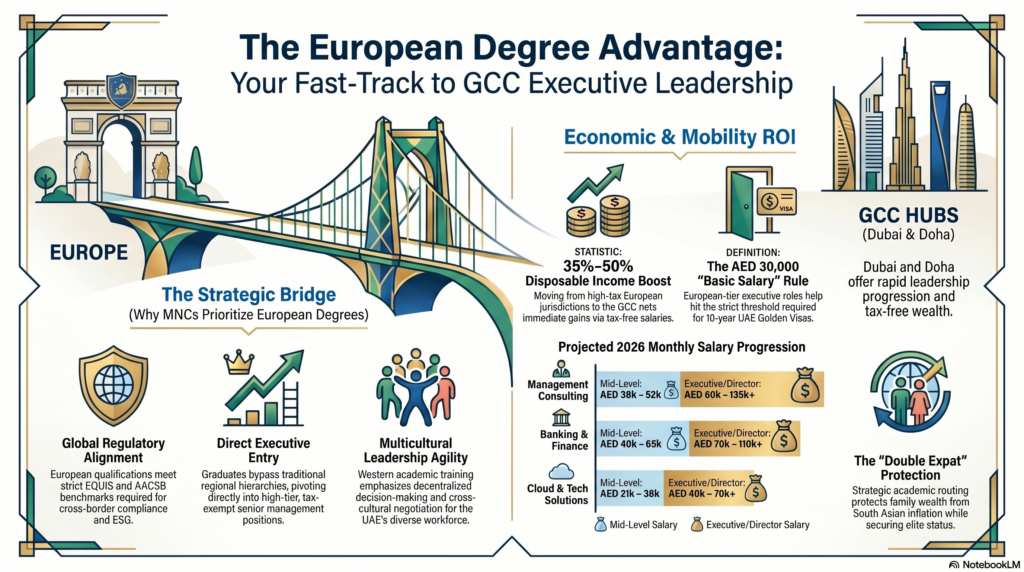
- The Executive Premium: Dubai MNCs prioritize European degrees because they signal strict compliance training, global strategic agility, and alignment with Western regulatory frameworks like EQUIS/AACSB.
- Rapid Hierarchy Bypass: A European credential acts as structural arbitrage, allowing mid-career professionals with Eurozone experience to skip entry-level bottlenecks and pivot directly into tax-exempt senior management roles.
- The “Double Expat” Bridge: For South Asian professionals, routing their education through Europe helps them bypass regional career ceilings and local inflation, transforming their profile to command high-paying Gulf executive roles.
Content Hook:
Yes. Dubai multinational companies often prefer executives with European degrees because they signal internationally recognized accreditation, cross-border leadership experience, and stronger alignment with executive hiring requirements in sectors such as banking, consulting, logistics, healthcare, and technology.
Key reasons include:
- Strong compliance and governance training
- Better access to Eurozone career pathways before GCC entry
- Greater likelihood of reaching executive salary levels linked to UAE Golden Visa eligibility
The corporate landscape of the Eurozone is increasingly defined by stagnant salary growth, complex labor restrictions, and aggressive progressive taxation. In stark contrast, the Gulf Cooperation Council (GCC) regions led by the hyper-growth executive hubs of Dubai and Doha—offer unparalleled tax-free wealth creation and rapid leadership progression. For ambitious South Asian students and high-net-worth expat families navigating local currency volatility, choosing where to pursue higher education is no longer just about academic prestige. It is a calculated step toward maximizing global mobility and securing a long-term economic safe haven. Holding a top-tier European qualification has emerged as the definitive mechanism to bypass entry-level regional bottlenecks and unlock senior leadership roles within Middle Eastern multinational corporations (MNCs).
Dubai multinational companies strongly prefer European university degrees for senior executive roles, valuing their rigorous compliance standards, global prestige, and proven mobility ROI within GCC corporate frameworks.
Proprietary executive recruitment data across the UAE reveals clear hiring patterns that favor European alumni. As multinational organizations scale their operations across the Middle East, they demand leadership talent that possesses a sophisticated blend of Western regulatory fluency and cross-border strategic agility. Rather than climbing a slow, traditional corporate ladder domestically, mid-career professionals and international graduates are weaponizing their European university credentials. This structural arbitrage enables them to pivot directly into high-tier, tax-exempt executive positions in the Gulf, generating an immediate, exponential return on their educational investment.
TL;DR Highlights:
- Strategic Academic Arbitrage: For South Asian and Middle Eastern students, a top-tier European degree serves as a high-leverage structural bridge to bypass entry-level regional bottlenecks, moving directly into premium executive roles in Dubai and Doha.
- The “Basic Salary” Rule Change: To secure 10-year residency via the UAE Golden Visa, skilled professionals must hit the AED 30,000 monthly threshold exclusively through their basic salary, as regional immigration authorities no longer factor in total compensation or allowances.
- Oman’s Historic Fiscal Shift: Oman breaks historic GCC ground by introducing a 5% personal income tax via Royal Decree No. 56/2025; effective January 1, 2028, it impacts high-earning individuals making over OMR 42,000 (~USD 109,000) per annum.
- Western Compliance Premium: Multinational corporations in the DIFC and QFC aggressively target European alumni because their academic training naturally aligns with complex cross-border compliance, ESG metrics, and international common-law frameworks.
- Double Expat Protection: Pursuing an education in Europe allows international students from inflating South Asian economies to protect family wealth, access global mobility, and re-enter the Gulf market with elite Western corporate status.
1. The Executive Premium: Do Dubai MNCs Prefer European Degrees?
Dubai multinational companies prioritize European university degrees for executive placements because they align with complex cross-border compliance, ESG frameworks, and global strategic operations required in the GCC.
Rigorous Institutional Accreditation
- Global regulatory alignment: Top-tier European qualifications are heavily prioritized by corporate headhunters due to strict EFMD (EQUIS) and AACSB quality benchmarks.
- Institutional prestige premium: Multinational firms operating in the Dubai International Financial Centre (DIFC) equate European business school alumni with world-class operational governance.
- Risk mitigation metrics: Hiring executives with European academic backgrounds minimizes localized onboarding friction, as these candidates are already trained in strict Western corporate compliance standards.
Cross-Border Mobility
- Streamlined corporate relocation: Holding an accredited European degree significantly reduces the time required to clear strict multi-jurisdictional background checks.
- Inter-company network access: International candidates leverage regional alumni chapters to transition rapidly from Western capitals into GCC leadership matrix roles.
- Visa priority status: Accredited degrees allow executive search firms to expedite high-level administrative clearances through local human resource registries.
Multicultural Leadership Alignment
- Demographic management capability: European university curriculums focus intensely on cross-cultural negotiations, directly preparing executives to manage the UAE’s highly diverse workforce.
- Language and diplomacy: Graduates bring refined diplomatic communication skills necessary for interfacing with sovereign wealth funds and local ministries.
- Strategic agility training: Case-study methods utilized in Western Europe emphasize decentralized decision-making, which is highly prized by MNCs scaling operations across emerging markets.
2. Corporate Leadership Fast-Tracks from Europe to Dubai
The European-to-Dubai corporate fast-track allows professionals with three to five years of Eurozone experience to bypass traditional regional hierarchies, advancing directly into senior management roles in the GCC.
The timeline to transition from a top-tier European university into a lucrative GCC executive role has compressed significantly. International graduates frequently utilize post-study work frameworks—such as Ireland’s 24-month Stamp 1G graduate permission or the UK’s Graduate Route—to build crucial corporate experience at European headquarters before executing a high-leverage transfer to Dubai or Doha. This strategy establishes a premium professional pedigree that regional hiring managers actively target.
| Sector | Mid-Level European Alumnus Salary (Monthly) | Executive/Director Salary (Monthly) | Source Verification URL |
| Management Consulting | AED 38,000 – AED 52,000 | AED 60,000 – AED 135,000+ | Michael Page UAE 2026 |
| Banking & Financial Services | AED 40,000 – AED 65,000 | AED 70,000 – AED 110,000+ | Michael Page UAE 2026 |
| Cloud & Tech Solutions | AED 21,000 – AED 38,000 | AED 40,000 – AED 70,000+ | First Point Group UAE 2026 |
3. Safe-Haven & Mobility ROI: Navigating the Tax Shift
Relocating from high-tax European jurisdictions to Dubai or Doha nets executives an immediate 35% to 50% increase in disposable income via tax-free basic salaries and structured corporate housing allowances.
A. The Doha-Dubai Executive Corridors
Multinational firms coordinate executive placements across Qatar and the UAE by matching Western academic backgrounds with synchronized regulatory spaces like the DIFC and QFC.
- Dual-hub corporate architecture: Major financial institutions operate seamless talent pipelines between the Dubai International Financial Centre (DIFC) and the Qatar Financial Centre (QFC).
- Accelerated talent deployment: European degree holders are frequently rotated between these twin nodes to oversee regional asset portfolios and manage infrastructure financing.
- Arbitrage of corporate laws: Because both the DIFC and QFC utilize independent, English common-law frameworks, Western-educated executives operate within highly familiar legal environments.
- Optimized capital preservation: Senior executives use this inter-GCC corridor to hedge against currency depreciation by parking liquid assets across diverse financial free zones.

B. Maximizing Oman and Bahrain Dual-Status Tax Advantages
A European qualification optimizes corporate structuring across secondary GCC nations like Oman and Bahrain by positioning executives for specialized, cross-border entity management roles.
- Strategic tax routing: Savvy corporate professionals leverage local dual-status residency options to legally insulate their personal wealth from foreign tax liabilities.
- Treaty network exploitation: Holding executive positions across Oman or Bahrain allows individuals to utilize extensive Double Taxation Avoidance Agreements (DTAA).
- Corporate entity optimization: Multinational corporations utilize European-trained leaders to set up low-tax onshore holding companies that safely manage regional supply chains.
- Asset protection strategies: This geographic placement helps high-earning South Asian expat families protect their capital from aggressive wealth taxes in their home jurisdictions.
4. The Localization & Trust Hooks
Elite financial institutions and regional corporate entities—such as Emirates NBD, First Abu Dhabi Bank (FAB), Mashreq, and Riyadh Bank—wield immense capital influence across the Middle East. When these Tier-1 banking hubs source executive talent to manage their most sensitive portfolios, they look directly to Western-accredited profiles. For regional hiring committees, a European qualification serves as a primary trust signal, guaranteeing that the candidate possesses the strict financial-modeling capabilities and risk-management training required to deploy capital safely.
This educational path is particularly crucial for navigating the complex anxieties faced by “Double Expats” from South Asia. Students from India, Pakistan, and Bangladesh often face severe career ceilings and intense local currency inflation if they try to enter the Gulf market directly from their home countries. By routing their academic journey through top-tier European institutions, they undergo an immigration transformation. They use the Western degree as a highly strategic structural bridge, enabling them to secure elite, high-paying executive roles in Dubai while maintaining close physical proximity to their families in South Asia.
Furthermore, global executive search firms in Dubai use strict academic filters to manage high applicant volumes. Candidates who present high GMAT Focus Edition scores alongside an elite European business school degree are immediately placed into priority recruitment pools. This specific academic profile stands in stark contrast to regional direct-admission pathways, which often lack standardized global benchmarking. Headhunters know that a candidate who has survived the intense competitive environment of a Western university is naturally better equipped to navigate the high-stakes, fast-moving corporate demands of the modern GCC market.
FAQ:
1. Do Dubai multinational companies require European university degrees for C-suite roles?
While not legally mandatory, Dubai multinational companies heavily prefer European university degrees or elite global business school credentials for C-suite roles to meet strict institutional investor and cross-border regulatory standards.
2. What is the average timeline for an executive visa transition from Europe to the UAE?
An executive visa transfer from Europe to the UAE typically takes two to four weeks under standard corporate sponsorship, though it can be expedited via the UAE Golden Visa platform if the applicant’s monthly salary exceeds AED 30,000. According to official parameters outlined by the Official Portal of the UAE Government, this 10-year residency pathway requires proof of a consistent monthly basic salary of at least AED 30,000, fully attested bachelor’s qualifications, and a specialized employment contract categorized under MoHRE Occupational Level 1 or 2.
3. How do Oman and Bahrain dual-status tax advantages work for European degree holders?
European qualification holders use their credentials to secure specialized corporate positions in Oman or Bahrain, allowing them to legally utilize regional double-taxation treaties and eliminate home-country income tax liabilities entirely.
4. Does Oman levy a personal income tax on expatriate executive salaries?
Oman has legislated a 5% personal income tax on individual net income exceeding OMR 42,000 annually under Royal Decree No. 56/2025, which officially takes effect on January 1, 2028, for both citizens and expats. According to official parameters detailed by KPMG and EY Global, this tax applies to the worldwide income of tax residents (individuals staying over 183 days per year in the Sultanate) and requires employers to implement strict compliance and payroll withholding infrastructure ahead of the deadline.
5. Can allowances be used to bypass the UAE Golden Visa salary threshold?
No, the UAE Golden Visa framework enforces a strict AED 30,000 minimum monthly threshold based entirely on basic salary, meaning housing, transport, and variable corporate bonuses are completely excluded from the calculation. Official regulatory documentation verified via the Abu Dhabi Residents Office mandates that skilled professionals must submit 6 months of consecutive bank statements alongside a Ministry of Human Resources and Emiratisation (MoHRE) employment contract showing a basic wage of AED 30,000 or higher to qualify.
6. What role does a European degree play in bypassing Bahrain’s local hiring restrictions?
While Bahrain enforces a mandatory 21-day local talent recruitment waiting period before corporations can look abroad, a high-tier European qualification enables MNCs to justify immediate expatriate executive sponsorship to regional labor authorities. Holding a verified, globally accredited Western degree allows multinational corporations to classify the candidate as specialized exceptional talent, clearing administrative hurdles within the unified GCC corporate framework.