

Table of Contents
Quick Take: Baseline Metrics
- Structural Shortages Over Cyclical Trends: Industries like AI, semiconductor logistics, and specialized healthcare are anchored by deep-seated labor deficits. Even when overall economic growth stalls, these vacuums persist, forcing EU governments to keep immigration doors open.
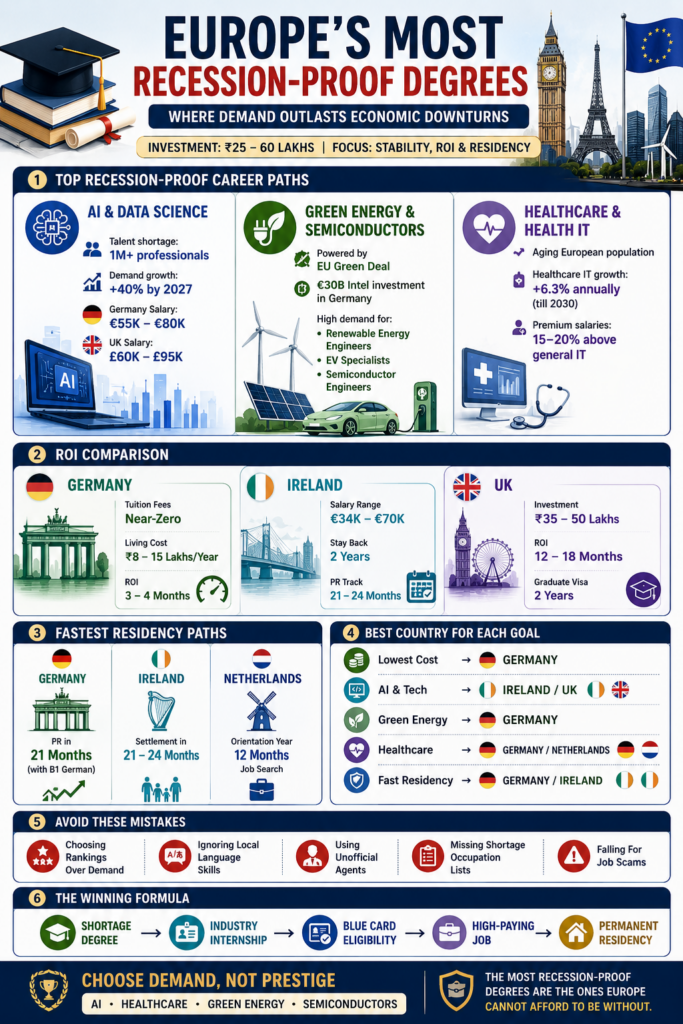
- The 12-to-18-Month ROI Rule: In high-barrier hubs like the UK, your starting salary in a shortage field should allow you to clear your educational capital within 12 to 18 months of entering the workforce. In Germany, where public university tuition is near-zero, recovering your living expenses (8 to 15 lakh INR) frequently takes just 3 to 4 months of full-time employment.
- Targeting Lowered Visa Thresholds: Selecting fields explicitly designated as shortage occupations by European governments dramatically simplifies the post-graduation transition. These tracks lower the minimum salary bar required to secure a residency permit, giving you a distinct edge over general business or humanities graduates.
Content Hook:
For families in cities like Dubai, Mumbai, and Riyadh, the decision to pursue a foreign degree is a major life investment that weighs heavily on every household. The financial commitment often falls within the Tuition Fee Range: 25 to 60 lakh INR, a significant sum that demands more than just a certificate in return. Having advised families across the GCC and South Asia, I have seen the primary concern shift from simple university prestige to genuine economic safety. In an era of global instability, students are looking for a shield against market volatility. This guide identifies the specific European pathways where structural demand outweighs economic cycles, ensuring your family investment delivers a secure and predictable return.
TL;DR Highights:
- Focus on Structural Shortages over Cyclical Trends: Sectors like AI and Healthcare are protected by long-term labor gaps that persist even when the broader economy slows.
- The 12 to 18 Month ROI Rule: In the UK or Canada, a high-value degree should pay for itself within this timeframe. For Germany, the ROI is often an aggressive 3 to 4 months due to near-zero tuition.
- Prioritize Blue Card Shortage Occupations: Selecting fields listed as shortage occupations by EU governments lowers the salary threshold required for residency and long-term stability.
- Dual-Skill Value: The strongest candidates combine technical depth, such as Engineering, with domain-specific knowledge in sectors like Healthcare or Green Energy.
- Location Strategy: Choosing the country is as important as the course. Germany is optimal for cost-efficiency while Ireland serves as a key hub for Tech and Pharma.
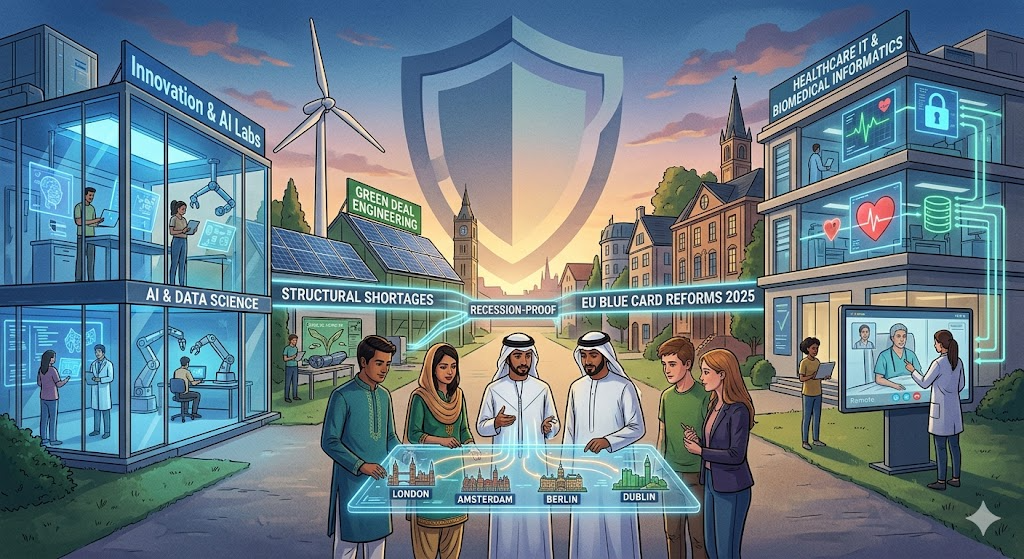
The European labor market in 2026 is defined by two primary shifts: the Green Transition and Hyper-Digitization. These movements have created a massive vacuum for skilled professionals that local talent cannot fill. For students applying from the GCC or South Asia, the focus must be on sectors where EU governments have active initiatives to attract non-EU talent to fill structural gaps. These fields are not just growing; they are becoming the foundation of the modern European economy.
The AI and Data Science Juggernaut
The global AI talent shortage currently exceeds 1 million qualified professionals, a gap that is widening as industries ranging from finance to logistics integrate smart automation. Every major European economy is competing for Machine Learning Engineers and AI Research Scientists to drive innovation. The implementation of the EU AI Act has also created a new category of high-paying roles in AI Governance and compliance. For those targeting top-tier outcomes, institutions like Imperial College London, the University of Amsterdam, or the University of Edinburgh provide direct employer pipelines.Salary Benchmarks for AI and Data Science (2026):
- Germany Machine Learning Engineer: Salary Benchmark: €55,000 to €80,000.
- UK AI Research Scientist: Salary Benchmark: £60,000 to £95,000.
- Canada Data Scientist: Salary Benchmark: CAD 70,000 to CAD 100,000.Reality Check Box
- What students say: AI will replace entry-level coding jobs.
- What documents show: Demand for AI specialists is growing by 40 percent through 2027 as roles move from tech-only to every industry.
- What it means for you: Focus on specialized Master’s programs in AI Research or Business Analytics rather than general IT to remain competitive.
Engineering the Green Deal and Semiconductor Future
EU climate goals are driving an unshakeable demand for Renewable Energy Engineers and Electric Vehicle (EV) Technicians. Simultaneously, the semiconductor sector faces a critical skills gap in design, fabrication, and packaging. The European Chips Act is fueling massive investments, such as the 30 billion Euro Intel project in Germany, creating thousands of permanent roles. Leading technical universities like RWTH Aachen, Technical University Munich (TUM), and TU Eindhoven are at the heart of these “Silicon Saxony” and mechatronics hubs.Reality Check Box
- What students say: Mechanical engineering is a dying field.
- What documents show: The Industry 4.0 revolution in Germany and Nordic countries depends entirely on mechanical experts who understand robotics and semiconductors.
- What it means for you: Target universities with strong industry partnerships where practical training in cleanrooms or virtual labs is part of the curriculum.
Healthcare and Biomedical Informatics: The Perpetual Shortage
Healthcare remains a recession-proof sector due to an aging population and systematic modernization. While the need for Registered Nurses is constant, a significant trend is the rise of Healthcare IT. In the Netherlands, the healthcare IT technology workforce is projected to grow by 6.3 percent annually through 2030. Roles for Clinical Data Engineers and Security Architects offer a specialized path for tech-minded students.Reality Check Box
- What students say: Healthcare jobs are only for doctors and nurses.
- What documents show: Massive demand exists for Clinical Data Engineers and Healthcare Security Architects to manage digital health infrastructure.
- What it means for you: If you have a tech background, Healthcare IT offers a 15 to 20 percent salary premium over general IT roles due to specialized regulatory knowledge.
Navigating the 2025 EU Blue Card Reforms
The 2025 reforms have made these degrees significantly more recession-proof by easing the pathway to permanent residency. Key changes include lowered salary thresholds, which now require only 1.0 to 1.6 times the national average salary. Crucially for professionals from Bangalore or Hyderabad, 3 to 5 years of relevant professional experience can now replace a formal degree for eligibility in IT and cybersecurity roles. The EU Blue Card supports career stability for South Asian graduates. These changes ensure that international talent can transition from study to work with fewer administrative barriers.
What students on Reddit and Quora keep repeating?
- Claim: You need a PhD for high-paying AI jobs.
- Reality: An MSc is often the industry standard, though specialized research roles do prefer PhDs.
- Claim: Germany is free but you will never find a job without fluent German.
- Reality: English is common in Tech and Startups, but German is required for roles in Healthcare or the Public sector.
- Claim: The US pays double what Europe pays.
- Reality: Absolute salaries are higher in the US, but visa uncertainty and the risk of being forced to leave are significantly higher compared to EU stability.
- Claim: Job offers from agencies are the fastest way in.
- Reality: Major scam risk. Official employers do not ask for visa fees or security deposits via Western Union.
- Claim: Internships are just cheap labor.
- Reality: In the EU, internships serve as a 6-month live interview. European universities collaborate with industrial companies to design curricula that often lead to full-time offers.
What could go wrong?
- Risk: Falling for employment scams in the GCC.
- How to reduce: Never pay money to a recruitment agency for visa processing. Legitimate firms are paid by the employer, not the candidate.
- Risk: High cost of living in hubs like Amsterdam or London.
- How to reduce: Look for secondary hubs like Manchester or Utrecht where salaries remain competitive but rent is lower.
- Risk: Visa rejection due to improper financial documentation or VFS appointment scarcity.
- How to reduce: Use authorized education consultancies and banks for “Blocked Accounts” (Germany) or official proof of funds early in the process.
- Risk: Degree mismatch with labor market needs.
- How to reduce: Choose Shortage Occupations listed on official government sites, such as MINT fields in Germany.
- Risk: Slow adaptation to European workplace culture.
- How to reduce: Participate in university-led Career Orientation workshops and cultural integration programs to bridge the gap.
| Country | Entry-Level Salary Range (EUR/Local) | Employment & Visa Requirements (2025-2026) | Source |
| USA | USD 95,000–120,000 (~EUR 89,000–113,000) | H-1B lottery system; OPT allows 1 year post-graduation work, extendable to 3 years for STEM graduates. | 1 |
| Luxembourg | €63,408 per year | EU Blue Card: Revised threshold of €63,408 effective March 18, 2025. High intra-EU mobility and inflation-adjusted salary scales. | 2 |
| Netherlands | €46,908 – €80,000 /yr (Local: €3,122 – €4,357 per month) | Highly Skilled Migrant (HSM) visa (2 weeks processing). 2026 thresholds: €3,122/mo for recent graduates (Orientation Year), €4,357/mo for professionals under 30. Orientation Year (Zoekjaar) allows graduates 12 months to find work without a job offer. English is the primary working language in IT/Data roles. | 2-6 |
| UK | £38,000 – £70,000 /yr (~EUR 45,000 – 83,000) | Skilled Worker Visa (2026): Minimum salary threshold of £41,700 per year and B2-level English required. Graduate Route Visa allows 2 years stay-back (3 for PhD). Skill shortage pathways exist for AI/Data Science. 5-year residency path to Indefinite Leave to Remain (ILR). | 1, 4, 6-8 |
| Germany | €45,934 – €65,000 /yr | EU Blue Card (2026): Min. salary €50,700 (standard) or €45,934 (AI/IT shortage). PR pathway shortened to 21 months with B1 German. Opportunity Card (Chancenkarte) points-based system and 18-month job seeker visa available. Mandatory Day-1 employer labor rights notification. | 1, 2, 6, 7, 9-11 |
| Ireland | €34,000 – €70,000 /yr | Critical Skills Employment Permit (CSEP): Min. salary €38,000 – €44,000 (standard) or €64,000. Threshold increases to €40,945 in March 2026. Fast-track settlement (Stamp 4) in 21-24 months. Third Level Graduate Scheme (Stamp 1G) allows 1-2 years stay-back for graduates. | 6-8, 12-15 |
Best-fit profiles
- The Tech-Pivot professional: A software developer from Bangalore or Hyderabad looking to move into AI or Cybersecurity.
- The Stability-Seeker nurse: A qualified nurse from Kerala or the Philippines seeking long-term relocation support in Germany or Ireland.
- The High-ROI student: An applicant with a limited budget targeting German public universities where living costs are the primary expense (Living Cost Range: 8 to 15 lakh INR).
- The Long-Term Immigrant: A professional from the GCC looking for a clear PR pathway in the Netherlands or Canada.
- The Research-First academic: A student aiming for semiconductor R&D in innovation hubs like Dresden or Eindhoven.
Misfit profiles
- The Language-Averse student: Someone looking for a guaranteed job without any willingness to learn a local language.
- The Hub-Only applicant: A student unwilling to move away from primary cities like Paris or London despite lower ROI.
- The Prestigious Title hunter: An applicant who ignores labor market demand data in favor of university rankings alone.
- The Short-Term Thinker: Someone who only prioritizes the first 6 months of salary over long-term residency pathways.
- The Agent-Reliant applicant: A student who relies on unofficial agents rather than using official university portals and verified services.
Next Steps
- Identify your target Shortage Occupation based on the EU Blue Card 2025 lists and shortage lists like MINT in Germany.
- Education consultancies facilitate university selection for Indian students and can help verify university industry partnerships with companies like SAP or Siemens.
- Prepare for required English (IELTS or PTE) or local language (German or French) tests at certified centers to avoid processing delays.
- Schedule your Visa Medical and verify all document requirements at local VFS centers or Embassies, as appointments can be scarce.
- Set up your financial Blocked Account or Student Loan through verified local banks to satisfy proof of funds requirements.
FAQ:
1. What is the average ROI for a UK Master’s in Data Science?
A Master’s in the UK typically involves an Investment Range: 35 to 50 lakh INR for tuition and living. With starting Salary Benchmarks: 40 to 60 lakh INR, most graduates earn back their investment within 12 to 18 months of employment. This sector is heavily protected by long-term EU structural funding and acute labor shortages.
2. Which countries offer the best post-study work visas in 2026?
Ireland provides a 2-year stay-back option for Master’s graduates, while Germany offers an 18-month job seeker visa. The Netherlands offers a 1-year orientation year for international graduates to secure a role. These options provide the necessary time to establish a career foundation without immediate visa pressure.
3. How do the 2025 Blue Card reforms affect South Asian students?
The reforms make it easier to qualify by lowering salary thresholds to a Range: 1.0 to 1.6 times the national average. Significantly, for IT roles, 3 to 5 years of professional experience can now bypass the formal degree requirement. This change is a major value-add for experienced professionals from tech hubs like Bangalore.
4. Are there tuition-free options for recession-proof degrees?
Yes, German public universities offer near-zero tuition fees for international students, making the ROI exceptionally high. Students only need to cover a Living Cost Range: 8 to 15 lakh INR, which can be earned back in just 3 to 4 months of full-time work. This makes Germany one of the most cost-effective pathways globally.
5. What is the Reality Check for AI replacing jobs?
While AI automates routine tasks, it is creating a 40 percent growth in demand for specialists who can manage and implement these systems. Roles are shifting toward high-value areas like AI Governance, ethical compliance, and system architecture. This means specialized degrees are becoming more valuable than general IT certifications.
6. How to identify a job scam in the UAE or GCC?
A job offer is a scam if you are asked to pay any money for a visa, ticket, or processing fee under the promise of a refund. Legitimate employers or recruitment firms never charge the applicant for these administrative costs. If an agency asks for an “enrollment fee” or “security deposit,” it is a major red flag.
7. What roles are in demand for the semiconductor sector?
There is a critical need for specialists in chip design, fabrication, and packaging, driven by the European Chips Act. Major industrial projects in regions like Saxony, Germany, are creating thousands of roles for mechatronics experts and microtechnologists. Graduates from TU Munich or RWTH Aachen are highly prioritized for these positions.
8. Is Healthcare IT a stable career in the Netherlands?
The technology workforce in Dutch healthcare is projected to grow by 6.3 percent annually through 2030. This growth is driven by mandatory core-system modernization and digital health initiatives aligned with European Interoperability Frameworks. These roles often offer a 15 to 20 percent salary premium over general IT positions.
9. What is the Stay-back option for Ireland?
International students who complete a Master’s degree in Ireland are eligible for a 2-year stay-back option to seek employment. This period is sufficient for establishing a career in Ireland’s booming tech and pharma sectors. This pathway is particularly popular for those seeking a balance of competitive salaries and residency stability.
10. How long does it take to get Permanent Residency via the Blue Card?
Blue Card holders can obtain permanent residence after 33 months of residence in most cases. This timeline can be shortened to 21 months if the holder can demonstrate B1-level local language proficiency. This accelerated path makes the Blue Card one of the most attractive work permits in the world.