
Table of Contents
Quick Take: Baseline Metrics
- Attestation Remains Essential: Gulf nations strictly mandate complete embassy attestation chains for interdisciplinary degrees.
- Four-Step Verification Process: Legalization requires clearing Home State HRD → MEA → Destination Embassy → MOFA tracks.
- Timeline Window Reality: Standard academic document processing pipelines securely require 7–25 working days to finalize.
Content Hook:
Imagine landing your dream university offer in London, Toronto, or Singapore, only to have your admission withdrawn because a single stamp on your degree was in the wrong color or issued by the wrong ministry. For the nearly 9 million Indian and South Asian expatriates living across the Gulf Cooperation Council (GCC), this isn’t just a nightmare; it is a frequent bureaucratic reality. Navigating the complex process of Apostille and Document Attestation has become a critical step for GCC-based students, as document verification is often a high-stakes, multi-jurisdictional puzzle that requires certificates to travel back to home countries like India before they are eligible for use in Western universities and immigration systems.

TL;DR: Apostille and Document Attestation
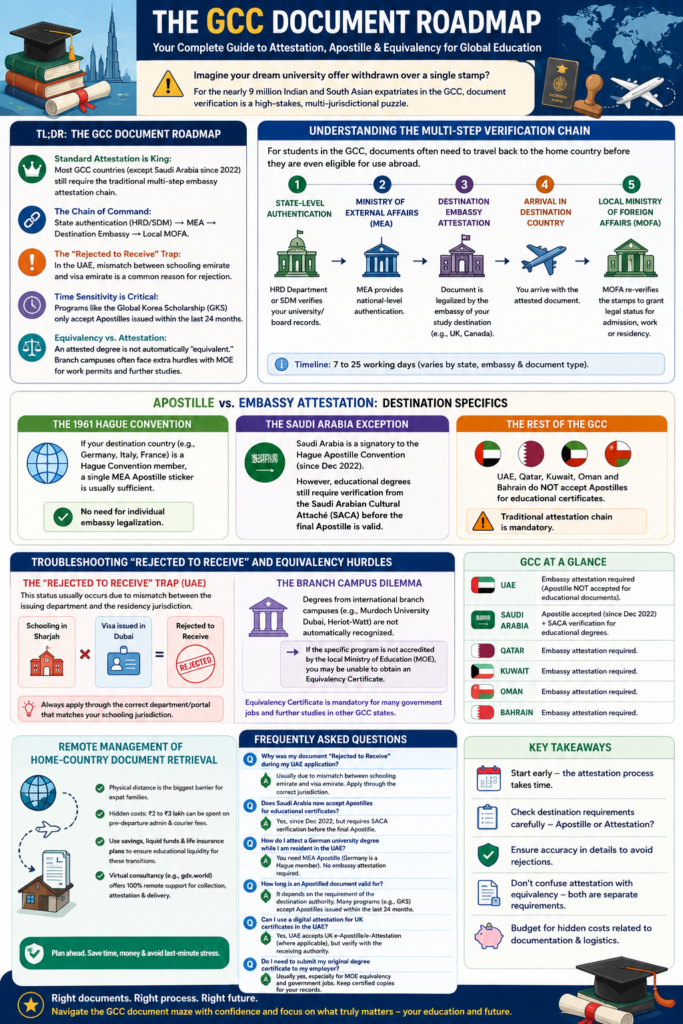
- Standard Attestation is King: While the world moves toward Apostilles, most GCC countries (except Saudi Arabia since 2022) still require the traditional multi-step embassy attestation chain.
- The Chain of Command: A document typically moves from state-level authentication (HRD/SDM) to the national Ministry of External Affairs (MEA), then to the destination embassy, and finally to the local Ministry of Foreign Affairs (MOFA).
- The “Rejected to Receive” Trap: In the UAE, administrative errors often occur if your schooling was in one emirate (e.g., Sharjah) while your visa was issued in another (e.g., Dubai).
- Time Sensitivity is Critical: Programs like the Global Korea Scholarship (GKS) often only accept Apostilles issued within the last 24 months.
- Equivalency vs. Attestation: Having an attested degree does not mean it is “equivalent.” Branch campuses in Dubai often face extra hurdles with the Ministry of Education (MOE) for work permits.
Understanding the Multi-Step Verification Chain
For students in the GCC, document authentication is rarely a local affair. If you are an Indian expat in Kuwait or Oman, your journey begins with State-Level Authentication. Depending on your degree type, you will need a stamp from the Human Resource Development (HRD) department or a Sub-Divisional Magistrate (SDM).
Once the state verifies your university records, the document must travel to the Ministry of External Affairs (MEA) for national-level authentication. Only after the MEA provides its seal can the document be presented to the embassy of the country where you intend to study (e.g., the UK or Canadian Embassy). Finally, once you arrive in your destination country, the local Ministry of Foreign Affairs (MOFA) re-verifies these stamps to grant legal status for employment or university admission.
What Is an Apostille?
An Apostille is a certificate issued under the 1961 Hague Convention that verifies the authenticity of a public document for use in another Hague Convention member country. For students, an Apostille confirms that an educational certificate, transcript, or degree is genuine and can be accepted abroad.
What Is Document Attestation?
Document attestation is the process of obtaining official verification from multiple government authorities, embassies, and foreign ministries so that a document can be legally recognized in another country.
What Is an Equivalency Certificate?
An equivalency certificate is an academic recognition document issued by a country’s education authority confirming that a foreign qualification is equivalent to local educational standards. It is commonly required for government employment, regulated professions, and certain postgraduate admissions.
Apostille vs Attestation vs Equivalency
While Apostille and attestation verify a document’s authenticity, equivalency verifies its academic recognition. A degree can be properly attested yet still require an equivalency certificate before it is accepted for employment or professional licensing.
Apostille vs. Embassy Attestation: Destination Specifics
One of the most confusing aspects for GCC students is whether they need an Apostille or Attestation.
The 1961 Hague Convention
If your destination country (like Germany or Italy) is a member of the Hague Convention, a single MEA Apostille sticker is usually sufficient. This replaces the need for individual embassy legalization.
The Saudi Arabia Exception
As of December 2022, Saudi Arabia is a signatory to the Hague Apostille Convention. This has significantly streamlined the process for expats in the Kingdom, though educational degrees often still require additional verification from the Saudi Arabian Cultural Attaché (SACA) before the final Apostille is valid.
The Rest of the GCC
Countries like the UAE, Qatar, and Kuwait generally do not accept Apostilles for educational certificates. They strictly adhere to the traditional attestation chain, which can take anywhere from 7 to 25 working days depending on the state and embassy workload.
Troubleshooting “Rejected to Receive” and Equivalency Hurdles
The bureaucratic “circular logic” of the GCC can be daunting. A common issue reported by students applying for the UAE Golden Visa or permanent residency abroad is the “Rejected to Receive” status. This often occurs when there is a mismatch between the issuing department and the residency jurisdiction. For instance, a student who graduated from a CBSE school in Sharjah but holds a Dubai-issued visa may have their application rejected simply because they applied through the wrong department’s portal.
| Process | Purpose | Where Accepted | Typical Student Use Case | Typical Timeline |
|---|---|---|---|---|
| Apostille | Verifies authenticity of a document | Hague Convention countries | Germany, France, Netherlands, South Korea | 3–10 working days |
| Embassy Attestation | Legalizes documents through embassy and MOFA channels | GCC countries and selected non-Hague destinations | UAE, Qatar, Kuwait, Oman | 7–25 working days |
| Equivalency Certificate | Confirms academic recognition | Local education ministries | UAE MOE, Saudi MOE applications | 2–12 weeks |
The Branch Campus Dilemma
Many students at international branch campuses (e.g., Murdoch University Dubai or Heriot-Watt) assume their degrees are automatically recognized. However, if the specific program is not yet accredited by the local Ministry of Education (MOE), students may find it impossible to get an “Equivalency Certificate,” which is a mandatory requirement for many government jobs and further studies in other GCC states.
Step-by-Step Attestation Process:
For Indian Degrees Intended for UAE Use
- Obtain notarization of educational documents.
- Complete state-level verification (HRD, Home Department, or SDM).
- Obtain attestation from India’s Ministry of External Affairs (MEA).
- Submit documents to the UAE Embassy in India.
- Complete final Ministry of Foreign Affairs (MOFA) attestation in the UAE.
- Submit attested documents to the university, scholarship authority, or employer.
Typical Processing Time
7–25 working days depending on jurisdiction and document type.
Typical Costs for GCC-Based Students
Students should budget for:
| Expense | Approximate Range |
|---|---|
| Notary and State Verification | ₹500–₹5,000 |
| MEA Apostille or Attestation | Varies by provider |
| Embassy Fees | ₹2,000–₹15,000+ |
| International Courier Services | ₹2,500–₹12,000 |
| Translation Services | ₹1,000–₹10,000+ |
Actual costs vary by country, document type, urgency, and service provider.
Common Attestation Mistakes That Delay Student Applications
Many GCC-based students lose valuable application time due to avoidable errors.
The most common mistakes include:
- Submitting documents issued in a different jurisdiction than the visa sponsor country.
- Using photocopies instead of original certificates.
- Incorrect spelling differences between passports and educational records.
- Missing transcript attestation while only attesting the degree certificate.
- Assuming Apostille alone is sufficient for GCC recognition.
- Ignoring equivalency requirements for government-regulated professions.
Remote Management of Home-Country Document Retrieval
For expat families, the physical distance from their home country is the largest barrier. The “hidden costs” of foreign education often include 2 to 3 lakh rupees just for pre-departure administrative tasks, including courier fees for sending original degrees back and forth across borders.
This is why many families now utilize dollar-denominated life insurance and savings plans to ensure that educational liquidity is available not just for tuition, but for these intensive administrative transitions. Virtual consultancy services have emerged to fill this gap, offering 100% remote document audits to ensure that the “chain of attestation” is perfect before a student ever boards a flight.
Why was my document “Rejected to Receive” during my UAE application?
This typically happens when your school and your visa jurisdiction do not match. You may need to re-apply using the specific department of the emirate where your school was located, even if your visa is from elsewhere
Does Saudi Arabia now accept Apostilles for educational certificates?
Yes, since late 2022. However, educational degrees still generally require a verification step from the Saudi Arabian Cultural Attaché (SACA) before the Apostille is considered fully valid for use inside the Kingdom
How do I attest a German university degree while I am resident in the UAE?
The process must start in Germany. Your degree must be attested by the university itself, then by the German federal authority, and finally by the UAE Embassy in Germany before the UAE MOFA will accept it
How long is an Apostilled document valid for?
While an Apostille technically does not expire, many institutional bodies (like the Global Korea Scholarship) require documents to be authenticated within 2 years of your application date.
Can I use a digital attestation for UK certificates in the UAE?
This is a new and sometimes unstable process. Some UK certificates are now digitally attested, but local bodies like MOHRE may still ask for a physical “label number” or AED transaction number to process your work permit
Do I need to submit my original degree certificate to my employer?
No. It is not standard practice for employers in the UAE to keep your original degree. You only need to share digital, attested copies for the visa process. Be cautious of any company that uses your original documents as leverage for contract extensions
Do GCC Students Need Apostille or Embassy Attestation?
In most GCC countries, educational documents require embassy attestation rather than a standalone Apostille. However, requirements vary depending on the destination country, document type, and intended purpose such as study, employment, or professional licensing.
How Long Does Document Attestation Take?
Most GCC attestation chains take between 7 and 25 working days, depending on document origin, embassy processing times, courier logistics, and ministry verification requirements.