


Table of Contents
Quick Take: Baseline Metrics
- Process Over Polish: Elite art institutions value your raw cognitive journey; portfolios must feature a 2:3 ratio of messy conceptual sketch iterations for every 1 final polished render.
- Skip the Foundation Year: Showcasing high undergraduate-level creative logic and strong 2D fundamentals allows international students to skip costly foundation programs entirely.
- Cliché Clearance Mandate: To cross the immediate 5-second review threshold, applicants must delete repetitive fan art, celebrity copies, and basic assignments to protect their unique voice.
Content Hook:
In places like Dubai, Mumbai, or Riyadh, you are often raised to believe that a high GPA and a perfect final result are the only metrics for success. This creates a paralyzing anxiety for creative arts & digital media admits applying to global art schools. You find yourself asking if your technique is good enough or if your portfolio structure is “correct.” The truth is that international reviewers care less about your perfection and more about your perspective. They are looking for the courage to show the work that failed before the work that succeeded. As your strategist, I am here to bridge that gap between your academic upbringing and the creative freedom required to win.
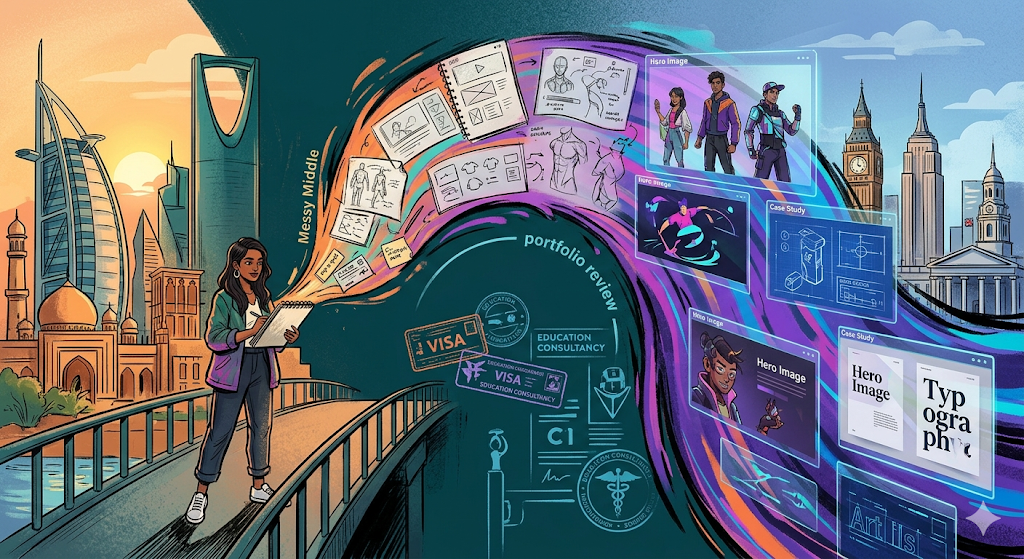
The current landscape of creative admissions has shifted from a gallery of finished renders to a deep dive into your cognitive process. Universities want to see how you solve problems and handle the “messy middle” of an idea. For GCC, Middle East, and South Asian students, this transition is the most critical hurdle to clear. A superior portfolio does more than just get you an offer. It can allow you to skip the mandatory Foundation year at elite schools like University of the Arts London. This saves a year of tuition and entry time by proving you already possess undergraduate-level creative logic.
TL;DR Highlights: Creative Arts & Digital Media Admits
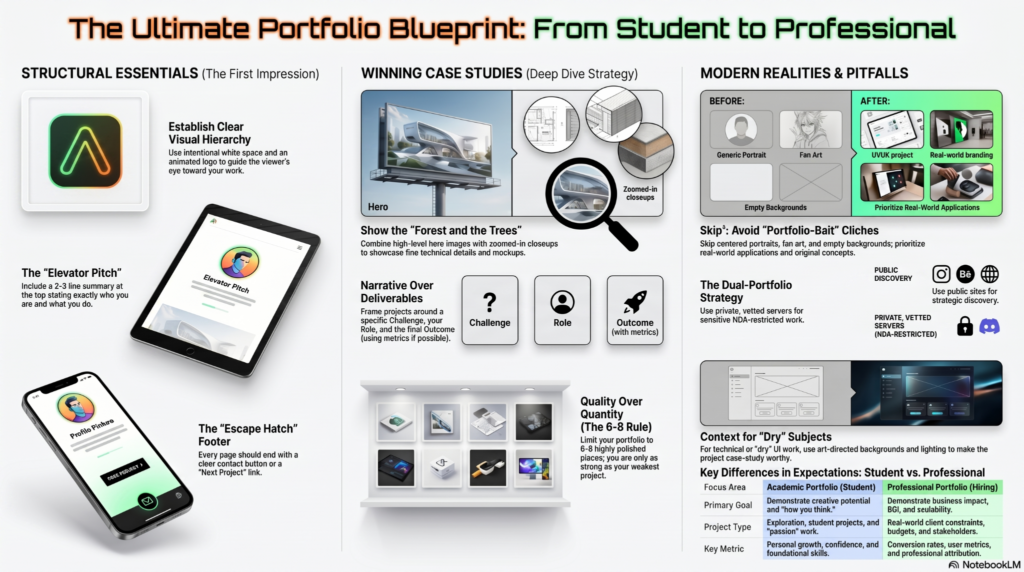
- Prioritize “Forest and Trees” layouts by showing the full visual overview alongside extreme closeups of technical details.
- Referencing “High Art” or historical figures like Francis Bacon provides more academic weight than referencing pop culture.
- Focus on “Successful Outcomes” rather than “Deliverables” by explaining how your design impacted a user or secured investor interest.
- Master 2D principles and movement before attempting complex 3D renders to avoid looking like an amateur.
- Maintain a dual-layer strategy with a public site for discovery and a private vetted space for deep work.
The Anatomy of a High-Acceptance Portfolio
A high-acceptance portfolio functions as a series of case studies rather than a simple folder of images. Every project must start with a “Hero Image” that serves as a five-second hook to stop the reviewer from scrolling. Once you have their attention, you must present the “Forest and the Trees.” This means you show the entire project in its environment and then zoom in on the fine details of the UI or brushwork. Admissions committees value creative logic for global applicants because it proves you are more than a pair of hands.
| Metric/Statistic | Value (2025–2026 Focus) | Practical Application/Industry Demand | Source |
| Global Creative Economy Growth | US$260 billion by 2026 | Indicates massive scale for digital creators and high demand for game designers with professional creative and technical skillsets. | 1, 2 |
| US Creative Arts Economic Output | $800 billion annually | Employs more people in the US, Europe, and Japan combined than the automotive industry, signaling strong ROI for graduates. | 3 |
| UK Creative Economy Contribution | £111.7 billion | Employs 1 in 11 people in the UK; highlights significant job growth in film, television, and digital media sectors. | 3 |
| CalArts Character Animation Acceptance Rate | 4% – 6% | High selectivity requires a curated portfolio of 30–40 pieces emphasizing observational skills and narrative storytelling. | 4 |
| Oxford Fine Art Admission Rate | 11.6% (1 in 8.6) | Reflects highly competitive elite programs; admission success relies on a portfolio score of 7+ out of 10. | 5 |
| Professional Portfolio Review Time | Under 2 minutes | Hiring managers scan 100+ portfolios daily; a 5-second impression threshold on showreels determines immediate candidate interest. | 6-9 |
| Art Portfolio Page/Slide Limit | 15–20 pages/slides | Standard institutional requirement (e.g., RISD, Falmouth); prioritizes 4–6 deep case studies over high volume. | 9–11 |
| Portfolio Curation Target | 3 to 8 high-quality projects | Industry recommendation to prevent hiring manager fatigue and ensure only the strongest, most relevant work is showcased. | 4–6 |
Beyond the Final Render: Documenting the Process
Schools like NYU and Emily Carr University are specifically looking for your sketchbook pages and low-fidelity prototypes. I advise my students to use the “Bacon Strategy” by referencing art history to prove they are ready for university-level discourse. One successful applicant referenced Francis Bacon to explain a specific texture in their work. The interviewers were amazed that a teen knew his name. This high-art context elevates you far above students who only draw from anime or video games.
Reality Check Box What students say: Only my polished, final work matters. What policy and trend shows: Admissions want to see the “messy” decision-making process. What it means for you: Include 2 to 3 slides of iterations for every 1 final piece.
Navigating Specializations: Game Design vs. Motion Graphics
Field-specific advice is not universal. If you are aiming for the NYU Game Center, you must demonstrate an interest in “Critical Play” and the social impact of games. I want you to talk about playing non-digital games like card games or sports to show you understand mechanics at a fundamental level. Mentioning the NYU Game Center Incubator as a goal shows you understand their commercial ecosystem. Conversely, for Motion Graphics, the standard is even higher. Education consultancies support portfolio refinement for South Asian students by emphasizing that showing bad 3D is worse than showing good 2D.
The Application of Storytelling
Your personality is the most valuable asset in your portfolio. One student used their personal statement to talk about their childhood obsession with Ninjago. They used that story to prove they had the tenacity to never quit. In your animation work, think about the “Fireball” example from the Futur. If a character kicks a ball and it turns into a fireball, you are telling a story that does not exist in reality. This exaggeration shows you understand how to use movement to convey emotion rather than just mimicking life.Reality Check Box What students say: I need to know every software. What policy and trend shows: Admissions value creative logic over tool mastery. What it means for you: Master 2D and basic principles before moving to 3D software.
The Global Portfolio Underground: NDAs and Discord
By 2026, the way working professionals build their reputations has fundamentally changed. Senior designers with major brand experience often have nothing to show on public sites because of Non-Disclosure Agreements. This has pushed the best creative work underground. Private Discord servers host vetted portfolios for working professionals to keep their work safe from AI scraping and casual browsing.
Protecting Work from AI Scraping
The risk of your style being swallowed by AI training datasets is a primary concern. Many artists are moving to a “Cozy Web” model where they only share deep work with a vetted group of 100 or 200 peers. However, I must warn you that Discord is not a legal shield. Private servers do not provide immunity from NDAs because people can still take screenshots. Your best strategy is to maintain a strategic public layer for recruiters and a private deep layer for your mentors.Reality Check Box What students say: I must have a public Behance. What trend shows: Private, vetted Discord servers are the new reputation hubs. What it means for you: Maintain a public “strategic” layer and a private “deep” layer.
Avoiding the “Art School Slayers”: Clichés and Common Pitfalls
Reviewers are exhausted by the same repetitive themes. If I see one more pencil drawing of an eye or a “Zentangle” pattern, I will know you are a student following an art class assignment rather than an artist. You must avoid being a slave to your reference photos. Common pitfalls include fan art of celebrities and those moody crouched figures that every teenager thinks are deep. These elements kill your unique voice because they show you are merely copying someone else’s concept.
The Problem with Fan Art and Celebrities
Drawing characters from Game of Thrones says everything about the show and nothing about you. It tells the committee that you do not have original characters or worlds. They want to see your ability to design a background or a creature from your own mind. If you include a celebrity portrait, you are basically showing a technical copy that lacks artistic license. Replace these with original character designs to prove you are a creator.
Reality Check Box
What students say: Fan art shows my skill.
What reality shows: It says nothing about your original concepts.
What it means for you: Remove all fan art, anime, and zentangles from your main selection.
Regional Context: GCC and South Asian Logistics
Navigating the logistics of a global application requires more than just art. Students from the GCC or South Asia must manage visa medicals and local education consultancies to ensure their paperwork is as strong as their art. While some think a website is mandatory, a well-structured PDF portfolio is a valid professional delivery method. Look at the work of Habib Saleem, who used a PDF to showcase high-quality typography and layouts successfully. This regional approach works as long as the hierarchy of information is clear and professional.
Reality Check Box
What students say: I need a complex website to be professional.
What trend shows: A well-structured PDF is a valid professional delivery method.
What it means for you: Focus on the layout and hierarchy regardless of the format.
What students on Reddit/Quora keep repeating?
- Claim: Standardized test scores like the SAT are required for NYU. Anxiety: Fear of low scores blocking entry. Reality: No. NYU is test-optional and many admitted students do not submit scores.
- Claim: My GPA is more important than my art portfolio. Anxiety: Tension over academic performance. Reality: Partly. While a high GPA shows discipline, your portfolio proves your practical ability to do the job.
- Claim: AI is going to take all the creative jobs by 2030. Anxiety: General career insecurity. Reality: No. AI is a tool for production, but the industry still demands human creative logic and strategy.
- Claim: I need to show I can use every 3D software. Anxiety: Overwhelming technical pressure. Reality: No. Mastering 2D principles is more important than being a “Spencer” level amateur in Cinema 4D.
- Claim: I cannot include unfinished projects in my application. Anxiety: Feeling that the portfolio is too thin. Reality: No. You can include work in progress to show you are an active creator.
What could go wrong?
- NDA Breaches: Sharing restricted client work in public Discord channels. Instruction: Verify your contracts before sharing any professional project in any digital space.
- Poor Lighting: Using low-quality photos of physical paintings or murals. Instruction: Take photos in context or use professional lighting to reflect the true media used.
- Mockup Fatigue: Using the same stock “cyberpunk” mockup for every project. Instruction: Vary your angles and show your work across multiple touchpoints like social and print.
- Broken Links: Having a portfolio website with links that lead to 404 errors. Instruction: Audit your site every week to ensure your “Say Hello” buttons actually work.
- Cliché Dependency: Filling your slides with “pencil eyes” or “zentangles.” Instruction: Challenge yourself to create complex environments that show you can handle a full page.
Best-fit profiles
- The Process-Oriented Experimenter: A student who documents every failure and sketch.
- The Social Impact Game Designer: Someone using games to teach empathy or emotional intelligence.
- The High-Art Reference Master: An applicant who connects their work to figures like Francis Bacon.
- The Business-Savvy Visual Communicator: A designer who focuses on metrics and investor interest.
- The 2D Technical Specialist: An animator who masters timing and movement before touching 3D.
Misfit profiles
- The Software-Only Technician: Someone who knows the tools but lacks creative logic.
- The Cliché-Dependent Illustrator: A portfolio filled with fan art and centered portraits.
- The “Polished Finalist” Purist: An applicant who refuses to show any messy sketches.
- The Disjointed Generalist: A portfolio with too many unrelated projects that lacks a theme.
- The Clinical Designer: Someone whose work is technically perfect but lacks personality.
Next Steps
- Audit for Clichés: Use our Link: Global Creative Schools Comparison to see how your current work stacks up against elite benchmarks.
- Document the Messy Middle: Go back to your sketchbooks and find the iterations that led to your final pieces.
- Write Your Project Briefs: Create a 2 to 3 line summary for every project explaining the challenge and the result.
- Refine Your Logistics: Read our Link: Visa Guide for GCC Students to ensure your medicals and paperwork are on track.
- Audit Your Layout: Ensure your Hero Image is the first thing a reviewer sees and that you show the Forest and the Trees.
FAQ:
1. Can I include unfinished work in my portfolio?
Yes, you are encouraged to include projects that are still in progress to show your active creative life. You should mark these clearly with a “Work in Progress” label so the reviewer understands the context. This demonstrates that you are constantly refining your ideas and building your skillset.
2. Do I need a professional domain name for my website?
While not strictly required, having a professional domain name adds a significant layer of polish to your application. It usually costs between $10 and $12 a year to secure a standard dot com domain. This small investment tells admissions officers that you are serious about your professional identity.
3. Is a PDF portfolio acceptable for international admissions?
A PDF portfolio is a perfectly valid delivery method, especially for students in the Middle East and South Asia where it remains a standard. You must ensure that the PDF is well-structured with a clear table of contents and a professional grid. Make sure the file size is optimized so it can be easily downloaded and reviewed.
4. How many projects should I include in my final selection?
An ideal portfolio for a university application should contain between 6 and 8 high-quality projects. If you include more than 10, you risk showing work that is outdated or not representative of your current skills. It is always better to have fewer projects that are deeply documented than many that are shallow.
5. Should I include my SAT scores if the school is test-optional?
If your SAT scores are on the lower end of the school’s average, you should not submit them to a test-optional program. Focus your energy on making your creative portfolio and personal statements as strong as possible. Admissions officers at places like NYU emphasize that test-optional truly means they will not penalize you for not submitting.
6. What should I avoid in my artist statement?
You must avoid using AI-generated fluff or generic marketing jargon that lacks your unique voice. Instead, focus on a specific personal story or a social goal you have for your creative work. Personal narratives about your journey as a “dreamer” are much more impactful than clinical descriptions of your skills.
7. How do I show social proof in my portfolio?
You can include testimonials from teachers, clients, or mentors who can vouch for your work ethic and talent. Highlighting awards like the National Honor Society or regional art competitions is also an effective way to build credibility. This shows that other professionals and institutions already value your contributions to the field.
8. What tools should I master first before applying?
Experts suggest that you should master 2D design and basic animation principles before you attempt to learn 3D software. Creative logic and an understanding of how to solve visual problems are far more important than tool mastery. Choose a few essential tools and learn them deeply rather than trying to be a generalist.
9. How do I document a team project?
When you include a project that was made with others, you must clearly define your specific role and contributions. Explain whether you were responsible for the character design, the coding, or the 2D compositing. This transparency shows that you are a good collaborator who understands how to work within a professional pipeline
10. .What makes a strong “Hero Image”?
A strong Hero Image is a high-quality visual that hooks the viewer immediately upon opening the case study. It should represent the absolute best version of the project and encourage the reviewer to keep scrolling. Think of it as the cover of a magazine that must sell the story inside.